![Best Microphones for Recording Acoustic Guitar [2025]](https://mcstaging.americanmusical.com/media/amasty/blog/cache/r/e/1200/600/recording_acoustic_resized.jpg)
There’s nothing that beats the pure, natural sound of an acoustic guitar. But capturing that purity isn’t always easy. Choosing the best microphone for recording your acoustic guitar can seem overwhelming at first, especially given the abundance of options and the many overlapping features that are available. Whether you're setting up at home or in a recording studio, it’s important to pick one that’s going to help you capture a sound with clarity and balance.
The ideal microphone for recording acoustic guitar should capture every strum with precision. A good ribbon or condenser microphone will surely do the trick, but it’s of course not just limited to ribbons. Let’s explore the top microphones for acoustic guitar, focusing on those that excel at capturing the full tonal range of the instrument, from the bottom-end warmth to the bright, shimmering high notes.
Top Condenser Microphones for Recording Acoustic Guitar
Condenser microphones have been regarded as one of the most versatile options for recording acoustic guitar, mainly due to their ability to capture a broad and detailed sound, highlighting the frequencies needed to provide plenty of depth and clarity.
There are two types of condenser microphones: large diaphragm (typically have a diameter of 1 inch or more) and small diaphragm condensers (smaller than the 1-inch diameter).
Large diaphragm condensers capture warmth and richness very well, while small diaphragm condensers have an excellent transient response and highlight the higher frequencies for a very clean and fine recording.
Both of these condensers are great options for acoustic guitars, and the best one to suit your needs will ultimately depend on the sound you’re looking to capture.
For a dreadnought acoustic that has a rich bottom end, perhaps you might prefer going with the large diaphragm to help point out those key areas within your sound. If you’re planning to do some more lead-style playing, a small diaphragm may better suit you. Either way, you won’t be disappointed with using a condenser microphone on your acoustic.
Condenser Microphone Advantages:
- Superior detail and clarity – Due to its broad frequency response, condenser mics bring tons of clarity and presence to your recordings.
- Reduced noise – Condenser mics have less noise than dynamic microphones, allowing it to pick up extra space and clarity from the instrument.
- Versatile applications – Great for studio recording, broadcasting, and live sound.
Disadvantages:
- Sensitivity to background noise – less suitable for noisy environments due to the ability to capture nuanced sounds.
- Higher cost – more expensive than dynamic microphones.
Below are some condenser microphones worth mentioning for recording acoustic guitars:

Neumann KM 184
The Neumann KM 184 is considered to be one of the best small-diaphragm pencil condensers for acoustic guitars. This is great for bringing out the higher ends of an acoustic guitar, providing transparency and presence.
Shure SM81
Considered a studio standard for many years, especially for live engineers when mic’ing acoustic guitars. This unidirectional, cardioid condenser captures all the nuances needed to deliver the detailed acoustic sound you’re familiar with.


Warm Audio WA-87 R2
A large diaphragm condenser based on the legendary U87 circuit that’s widely considered to be one of the greatest studio microphones ever designed, including three polar patterns (cardioid, omni, and figure 8). Excellent mid-range and works very well on acoustic guitars.
Shure KSM141
A pencil styled, small diaphragm condenser that includes dual patterns, dual-level pads, and dual high-pass filters. Its extended frequency response makes this a great microphone to use on acoustic instruments.
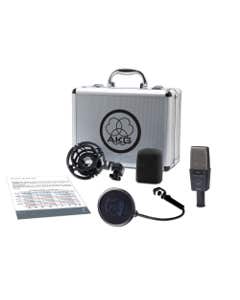
AKG C414XLS
Found in most recording studios, the C414 has been used on thousands of hit records, on stage with artists of every musical genre, and used by leading broadcast facilities the world over. With nine selectable patterns, this microphone makes as a great large-diaphragm condenser tool for recording, especially in acoustic instrument scenarios.
Universal Audio SP1
The SP-1’s classic cardioid design, high SPL tolerance, and smooth, clear top-end deliver a clean and consistent capturing of acoustic guitars. As a matched stereo pair, the SP-1 adds clarity, width, and dimension to your recordings.

Top Ribbon Microphones for Recording Acoustic Guitar
Ribbon microphones are the most sensitive of the bunch due to the thin ribbon of metal placed between two magnets. When sound comes into contact with the ribbon, an electrical signal is generated through electromagnetic induction.
There are two types of ribbon microphones: active and passive. Passive ribbon microphones require a high impedance preamp for performance due to their lower output levels. Active ribbon microphones have a greater compatibility with preamps and can handle phantom power, making them versatile in recording situations.
Okay enough with the engineering mumbo jumbo. Why is this important when it comes to recording acoustic guitar? Ribbon microphones function a bit differently than condensers, which is going to affect how your acoustic is sonically perceived.
Listed below are some of the advantages and disadvantages of using ribbon microphones.
Advantages of Ribbon Microphones Recording Acoustic Guitar:
- Natural sound reproduction – Known to capture a natural sound with a smooth velvety, warmth tone.
- Low noise – Ribbon microphones produce minimal background noise, ideal for recording cleanliness. Ribbon microphones take the lead over condensers in this category.
- Bidirectional pattern – These microphones are ideal for stereo recording, capturing the room ambiance.
Disadvantages:
- Low durability – ribbon microphones can be easily damaged by strong air blasts from loud sound or excessive handling.
- Lower output level – typically, ribbons tend to need a high-quality preamp due to their lower output levels compared to condensers and dynamics. So, you might want to think about leaning into the idea of getting one if you don’t currently have one.
While ribbon microphones can be expensive depending on which one you choose, they’re best suited for applications when naturalness and warmth are a priority. Acoustic guitars are great instances where these microphones can shine in capturing the full authenticity of the instrument, along with the room that it’s in. So, make sure you handle with lots of care!
Let’s take a look at a few ribbon microphones to give you a better idea on some of the characteristics that they bring to the table and see how they differ from the list of condensers we mentioned earlier.

Royer Labs R-121
The R-121 is an award-winning microphone that re-engineered ribbon microphone and is extremely versatile to take on a variety of demanding recording tasks. With an 8-figure pattern, and a warm and realistic flat-frequency response, it’s a great option for recording acoustic guitars.
SE Electronics VooDoo VR2
The VooDoo VR2 is considered to be one of the highest performing ribbon microphones for its price. Its active electronics make tracking quieter instruments simple and easy, capturing all the details needed to deliver a high-quality sound recording.


Beyerdynamic M 160
Delivering a warm, yet true-to life sound that captures the impulses and details of instruments, the M-160 is an incredible ribbon microphone for recording. Its great use of capturing the stereo field makes it an ideal choice when recording acoustic guitars and other stringed instruments.
AEA R84
If you want something that gives attention to the naturalness, and articulate mid-range area of the sonic spectrum, the AEA R84 is a great match. This ribbon microphone provides a smoother and warmer sound. This serves as a great option for recording any acoustic instrument.
Ready to Mic an Acoustic Guitar?
Whether you choose a condenser or ribbon microphone, it’s crucial to consider where you'll be using it and the type of sound you're aiming to get in your recording session. Ribbon microphones offer a warm and natural character, while condensers are more versatile and outline a more crisp and detailed sound. When recording an acoustic guitar, take time to assess what qualities you want to bring out in your recording since both are great options.
Have any questions about recording with condenser or ribbon microphones? Feel free to reach out to the AMS Customer Service crew at 800-458-4076. They’re eager to talk about all things related to microphones and their use. In the meantime, feel free to explore our website for more product details, ideas, and exclusive offers!