
The “odd couple” of the Fender family, the Jazzmaster and Jaguar models share a common body style and some other styling cues, but they are two very different animals. Let’s take a closer look at both models and see how they work and how they differ. Let’s start with the older sibling.
The Fender Jazzmaster
Dateline 1958, NAMM Show, Chicago, Illinois. Having achieved iconic status with his Stratocaster and Telecaster guitar models and industry-leading amplifier designs, Leo Fender had something new to introduce to the musical world: His newest design, The Fender Jazzmaster.

As the name implies, Fender’s intended customer for this instrument was jazz musicians. Jazz players at the time typically used archtop guitars, but they had increasingly started to use newer solid body guitars, like the Gibson Les Paul. Leo hoped to lure customers away from Gibson by offering an offset-waist body design to optimize comfort when playing in a seated position.
To compete with the Les Paul’s hotter humbucking pickups, Fender designed a low wide single coil pickup. The wide design gave it a mellower, jazzy output. Since the pickups were reverse wound, they could hum cancel in the center position, eliminating the annoying single coil hum found in other Fender designs.
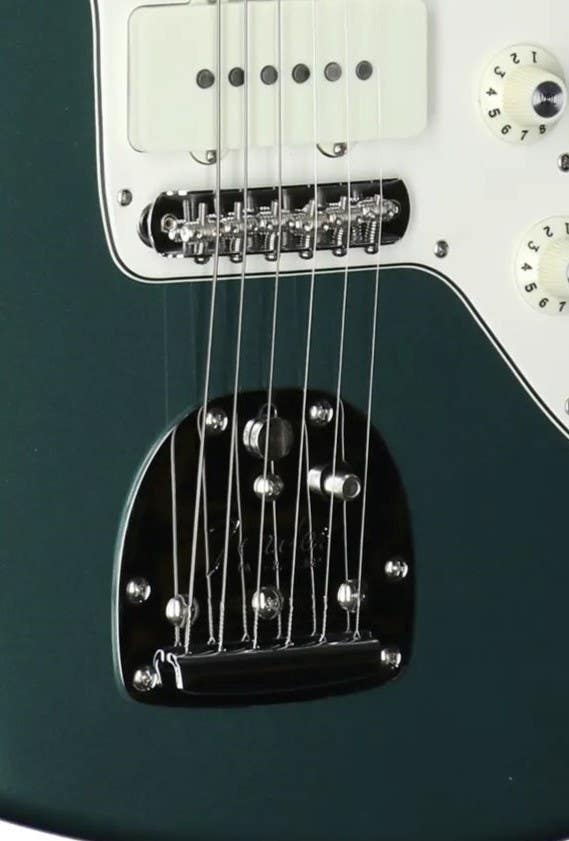
Jazzmaster Bridge and Tremolo System
A big feature of the Jazzmaster was the tremolo bridge design. At the time, the Strat was generally set up to tremolo down and return to rest on the top of the guitar.
The Jazzmaster bridge and tremolo design was more like what you’d find on an archtop tailpiece. It has a long amount of string after the bridge and an unusually long tremolo arm to create a spongey, loose tremolo feel. But unlike an archtop tremolo tailpiece, the Jazzmaster had a true floating tremolo. You could go up AND down.
The Jazzmaster’s tremolo system also featured a lock to immobilize the bridge, which is handy if you lose a string during a performance. The overall design of the bridge caused the guitar to have less sustain than its stablemates, and the open strings behind the bridge had a sympathetic vibration almost like a sitar.
Jazzmaster Electronics
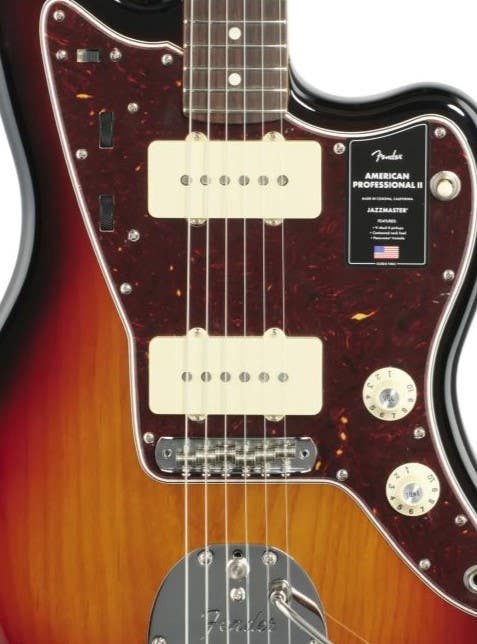
The Jazzmaster is set up with two pickups. The covers are typically cream plastic, and their wide rounded shape earned them the nickname “soapbars”. The lead volume, tone control, and 3-way selector switch are located in the lower bout.
What really sets the Jazzmaster apart from other guitars is the “weird” controls up top. In the upper bout, there’s a bewildering arrangement of two thumbwheel controls and a slider switch marked “Lead” and “Rhythm”.
Switching to Rhythm activates a second circuit that uses the neck pickup only with slight high frequency roll off. The thumbwheels now control tone and volume. Leo’s thought here was that a player could have two “preset” tone and volume settings to choose from quickly.
Switching to lead activates the 3-way toggle pickup selector switch and the separate volume and tone controls. The neck pickup retains a lot of the creamy tones and the bridge pickup is where the “chime” lives as it is picking up more of the strings behind the bridge.
Jazzmaster Features
As the most expensive guitar in Fender’s lineup at the time, the Jazzmaster was more richly appointed than its siblings. It was the first time Fender had ever offered a rosewood fretboard, having only used the more affordable maple on all previous models.
Since they were using a separate fretboard, Fender could install the truss from the top and glue the fretboard over the truss rod cavity — so the traditional walnut “skunk stripe” was gone from the back of the neck. They also were available in a variety of custom colors and featured body color-matched headstocks. It was also the first time Fender offered a bound fretboard for a more polished feel and presentation.
Fender Jazzmaster Build Specs
- Scale: 25.5”
- Frets: 21
- Body: Alder. Later models used Ash and Basswood
- Neck: Maple bolt on.
- Fretboard: Rosewood. Later models used Maple, Ebony, and Pao Ferro
- Markers: Clay Dot. Later models offered Pearloid Block and Black Block
Player’s Perspective: Fender Jazzmaster
The 25.5” scale length makes this guitar feel immediately familiar, since it’s the same scale as the Strat and Tele. The string tension is a little softer, especially as you head to the treble end of the range, because of the long string run from the bridge to the tailpiece combined, with the long run from the nut to the tuners.
The body is notably wider and longer than its stablemates, making the guitar a little heavier. However, the offset body shape with contours makes the Jazzmaster very comfortable to play seated or standing. As mentioned above, the tremolo has a loping, spongey feel and produces a gentle tremolo effect — no dive bombs here!
Unfortunately for Leo's plans, the jazz community was not having it. Traditional players still wanted archtop guitars with fat bodies, and even the newer converts to solid body guitars were not impressed enough to lay their Gibsons down. Initial sales were dismal, but the quirky, slightly jangly guitar was discovered and embraced by the burgeoning surf rock scene in Southern California, which is home to Fender’s operation and was heavily marketed with that target audience in mind.
The Fender Jazzmaster has found a permanent place in history as the go-to for musicians in the surf and indie-rock scene.
The Fender Jaguar

Fender released the Jaguar in 1962. Borrowing heavily on the vibe of the Jazzmaster, both models shared the same contoured, offset waist body shape designed for seated players.
When it was released, the Jaguar became the most expensive guitar in the Fender lineup. But this time, Fender was aiming directly at the surf market. The string scale length was shortened from 25.5” to 24” and the fret count was increased from 21 to 22, making the guitar very easy to play, especially barred chords.
Fender used two tall single coil pickups with metal shielding on the sides to block radio frequency (RF) — a fancy word for hum or interference. The taller coil choice made for a brighter tone with more “chime,” well suited to the jangly nature of surf music.
Jaguar Bridge and Tremolo System
One of the biggest differences between the Jaguar and The Jazzmaster is the bridge design and how the tremolo functions. One of the complaints about the Jazzmaster was that the tailpiece pulled the strings over a fixed bridge, causing tuning and intonation issues.
To remedy the problem, the bridge on the Jaguar moves forward and back when the tremolo is used, theoretically keeping the intonation the same in any position. How well this worked has been the subject of much debate over the years…
Like the Jazzmaster, the Jaguar tailpiece is set back from bridge about 6 inches, plucking or strumming these short open strings created a chiming harp-like effect, later used to great effect by the punk band Sonic Youth.
A flip-up rubber/foam string mute was utilized to overcome the difficulty of palm muting the covered strings at the bridge. There’s not much debate over the effectiveness of this feature; most were removed immediately.
Fender Jaguar Electronics
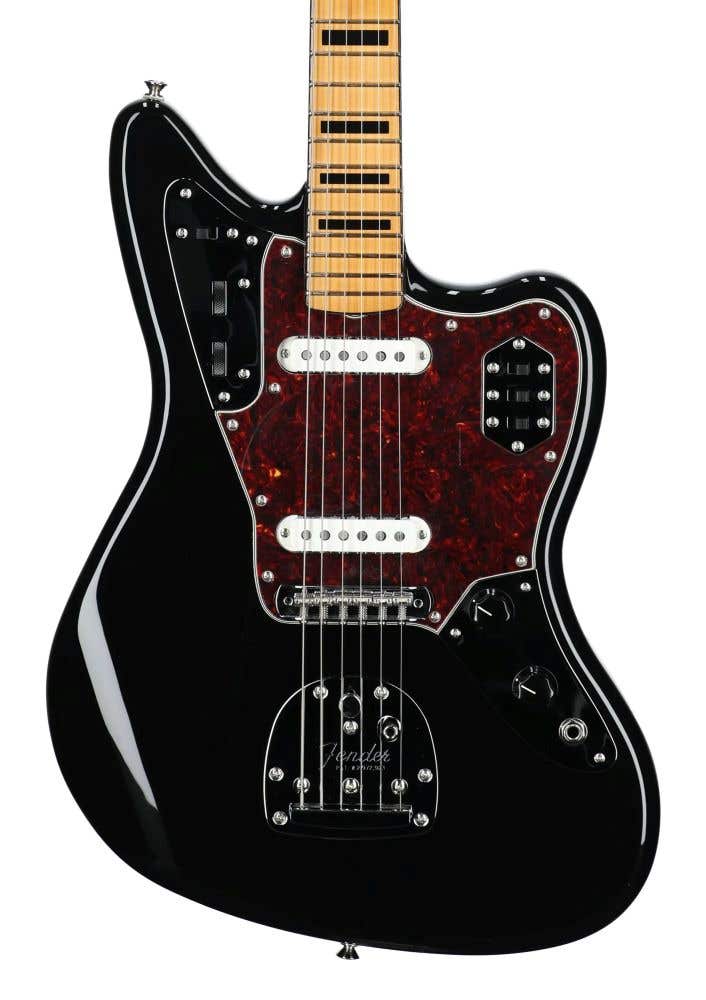
If the Jazzmaster wiring schematic was a little confusing, the controls on the Jaguar were downright perplexing. It shared the same dual-circuit path with two single coil pickups and separate volume and tone controls for lead and rhythm.
However, instead of using a toggle switch pickup selector, the Jaguar uses volume and tone knobs along with three slide selector switches on the lower bout. Two were on/off switches for the neck and bridge pickup, the third invoked a high pass filter. This came to be known as the “strangle switch.”
The upper bout controls consisted of a slider switch to turn on the rhythm circuit and two roller knobs to control volume and tone. The rhythm circuit was wired with both pickups on.
Unlike the Jazzmaster pickups, which were suspended from the pickguard, the Jaguar pickups were mounted directly to the body, giving the tone a little more meat. The tone of these pickup is more similar to a Stratocaster: bright and snappy bridge pickup with a slightly mellower neck pickup.
Fender Jaguar Build Specs
The new flagship of the Fender catalog featured a bound rosewood fretboard with clay dot inlay fret position markers, later upgraded to block pearloid inlays. A maple fretboard option with black block inlays was later offered as well.
- Scale: 24”
- Frets: 22
- Body: Alder. Later models used Basswood
- Neck: Maple bolt on.
- Fretboard: Rosewood. Later models used Maple, Ebony, Pao Ferro and Indian Laurel
- Markers: Clay Dot. Later models used Block Perloid and Black Block.
Player’s Perspective: Fender Jaguar
With 22 frets squeezed into a 24” scale, this guitar feels amazingly small. If you want a supernatural reach or have smaller hands, this would be your secret weapon. The string tension is a little softer, so it’s super easy to bend notes. The tremolo has a little more range of effect, due also to the shorter scale. Having the same wider, longer body as the Jazzmaster but with less neck, the instrument can feel a little less “centered.”
Counter to popular opinion, I kind of like the flip-up string mute.
As with the Jazzmaster, sales for the Jaguar were lackluster at best. By the late 1960s, the surf music scene was ebbing and new sounds from the UK were taking over the radio waves. Sporting minor tweaks and electronic changes, the model struggled to find a home and production was discontinued in 1975.
With such low sales figures to begin with, these guitars were rare on the used market. They didn’t fetch the same kind of money that a Strat or a Tele would command, which made them a natural choice for a broke “up-and-coming” musician.
The ‘70s advent of punk and later grunge rock and indie “shoe gazing” brought several Jaguar and Jazzmaster players into the spotlight, sparking renewed interest. Notable players like Kurt Cobain, Johhny Marr, Elvis Costello, J Mascis and many others helped make these guitars popular, causing Fender to reissue several iterations of both models. Historic reissues were built in the US and Japan. Signature series and modern variants were mostly built in Mexico, with Squier models built in Asia and Indonesia. Many of the more modern variants had a mix of humbuckers and single coil pickups.
Fender Jazzmaster vs. Jaguar: Which Is Right for You?
Despite the increased focus on these guitars, there are still very few around compared with the ubiquitous Strats and Teles in the world. If you want to have something a little different and maybe a guitar that the next player in the audition line does not have, consider adding one to your stash! But which one?
If you’re looking for some rhythm power, the Fender Jazzmaster might be your best bet. It’s an awesome rhythm guitar, sits nicely in a mix, and has a lot of chime and presence. It’s not the most aggressively voiced guitar for lead work, but nowadays we have an unlimited access to gain with pedals. There are plenty of Jazzmaster players who crank the gain. It feels a lot like a Strat with softer string tension.
The Jaguar has brighter pickups to give it more output, jangle, and snap. Its shorter scale makes for easy chording and sprawling solo potential. There’s still a lot of chime and harmonic overtones, especially in the bridge pickup, making it “float” in a mix.
In the final analysis, it would probably be a prudent move to buy both — obviously!
At American Musical Supply we have an insane selection of Fender electric guitars including plenty of Jazzmasters and Jaguars. If you want to talk about your next axe, call our toll-free Gear Hotline at 800-458-4075 to speak with one of our experts. Don’t forget about our easy no-interest financing and VERY fast and free shipping.
Whether you want to unleash the jaguar or get your jazz on, there’s a guitar for you right here at American Musical Supply.