When I was younger and getting my start in the wonderful world of live sound, I asked one of my colleagues, one with decades of experience under his belt, which microphones I should buy if I was going to be running my own live sound rig someday.
He ran his hand through his long greying hair, a habit of his when he was either deep in a workflow state or just about to dispense his unique flavor of expert advice.
Without much hesitation, he said…
“Six Shure SM58s and six Shure SM57s.”
He then added that you would be surprised how much those two mics can handle on their own. Basically, that you should start there and add additional specific mics only if there are very particular use cases that present themselves to you again and again.
Two Historic Shure Microphones with Iconic Reputations
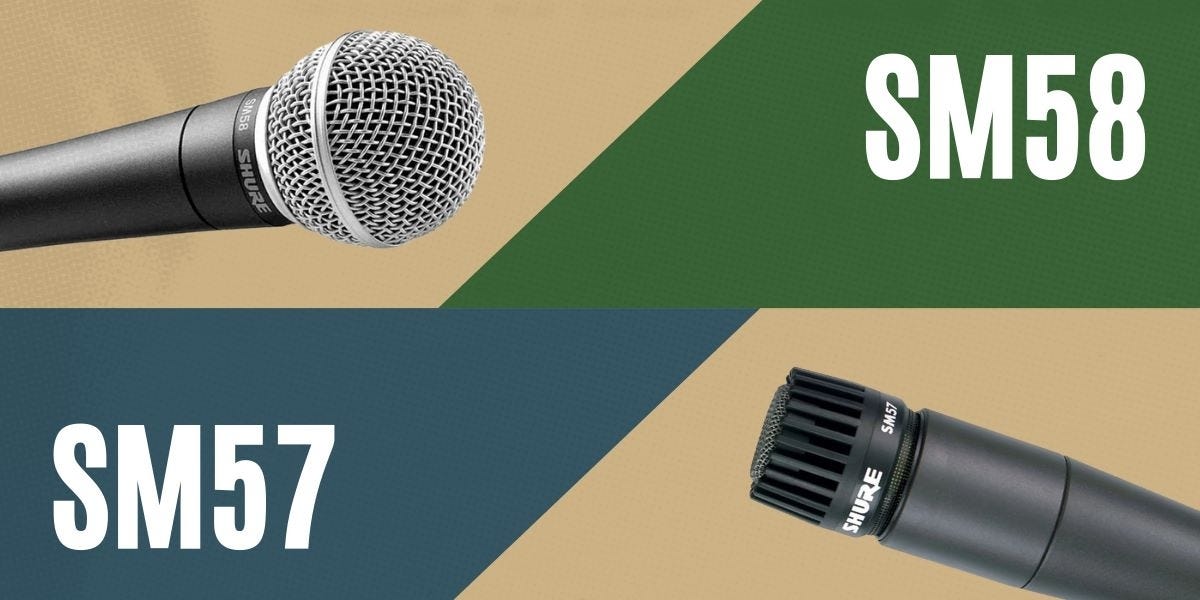
There have been epic amounts of physical and digital ink spilled over the decades talking about the SM58 vs. SM57. And why not? These are devices that have helped guide live and recorded music for generations.
So, I’ll keep my thoughts on the matter short and to the point.
The SM58 is basically the industry symbol for the straightforward, no-hassle dynamic vocal mic. And you can say the same for SM57 when it comes to dynamic instrument mics. Both are steady, durable, price-friendly, and incredibly versatile. Go to any venue or studio, and it’s practically a given that you’ll see them — and by that I mean MANY of them!
But did you know that these two have more in common than they have differences? Yep, it’s true! In fact, the whole “SM58 is for vocals” and “SM57 is for instruments” isn’t meant to be chiseled in stone. They are strong suggestions, yes, but you’ll soon find out there’s more than meets the eye.
Similarities Between SM57 vs. SM58
The engineering that drives both the SM58 and the SM57 is based on pretty much the same concepts, just housed in different bodies with different interior spacing.
They’re both dynamic cardioid mics that are easy to implement into any live or studio setting. Connect to any mic-level input and you’re ready to rock — no phantom power needed! They can both handle a hefty amount of gain before distorting, allowing for a comfortable amount of headroom for adjustments.
Both mics can also withstand identical high sound pressure levels (SPLs) before feedback and have comparably standard levels of output impedance (a measure of electrical AC signal resistance, which in microphones allows them to work over long balanced cable runs without audio degradation).
Differences Between the SM57 vs. SM58
The differences between the SM57 vs. SM58 are minor, but here is where the designation between “vocal” and “instrumental” do come into play, as there are certain specs that have been tailored to help with those specific applications.
Shure SM58 Specs
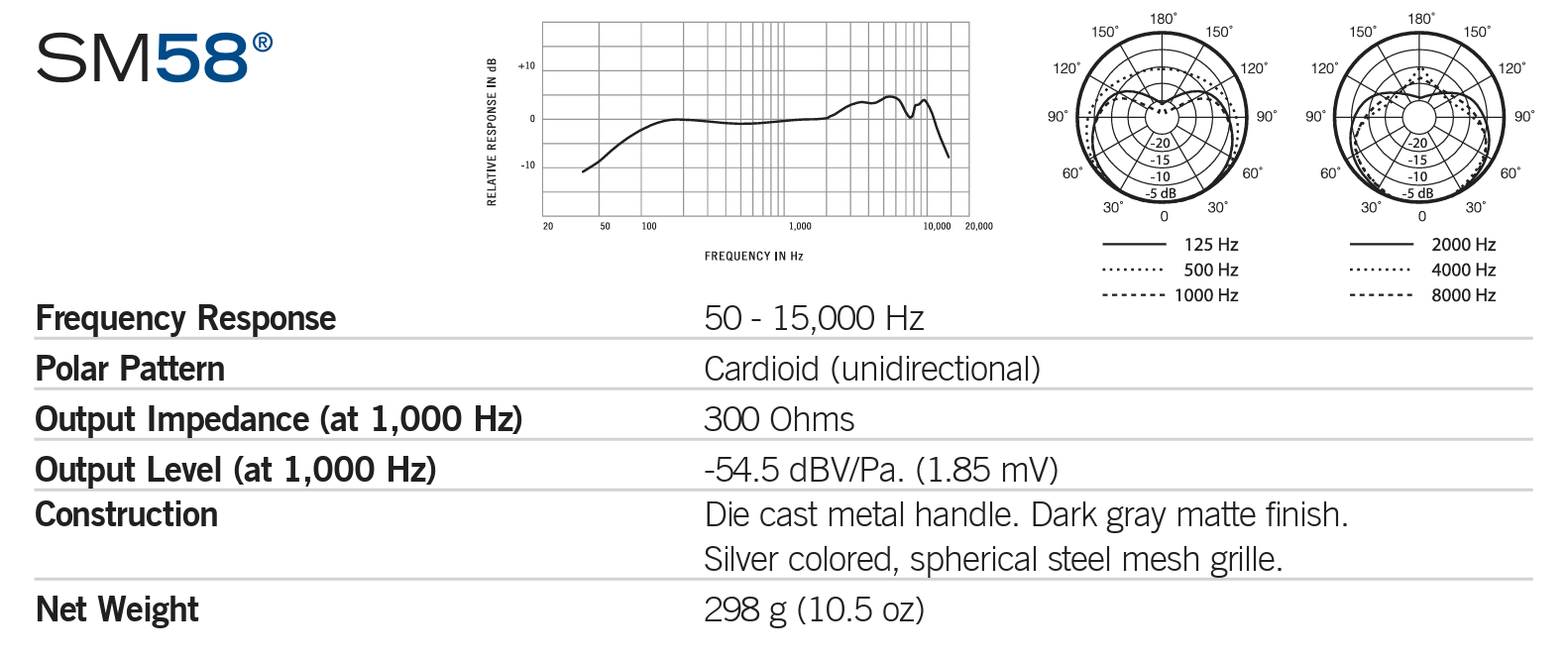
The most obvious trait of the Shure SM58 is its physical design, a classic-looking ergonomic handheld with a circular ball grille. There’s built-in control to help ease the sound of sharp vocal syllables from consonants (called “plosives”), and the grille’s wider surface area surrounding the capsule is helpful for capturing a wider berth of audio dispersion from someone’s mouth — especially when being held.
An SM58 also rolls off just a bit more bass (around 50Hz) and has a slightly boosted presence in the mids to higher mids (starting at 2kHz up to just over 6kHz), which gives you an extra bit of clarity for those lovely overtones that shimmer above the fundamental frequencies of the human voice.
Shure SM57 Specs
The Shure SM57’s cylindrical design and recessed grille bring the internal housing front and center, narrowing the forward-facing focus and rejecting frequencies from others angles at a slightly higher rate than the SM58. This directional nature is what makes the SM57 such a great multi-use instrumental and amplifier microphone.
It also drops down to cover lower bass frequencies (around 40Hz) and doesn’t have quite the same mid-range boost in the mids, so it can stay a bit truer to the natural character of the instruments it’s mic’ing.

Get Ready to Experiment – These Aren’t Just Single-Use Mics!
Now that you know the similarities and differences between the Shure SM57 vs. SM58, here comes the fun part! Like a musical Swiss Army Knife, these two mics can be applied to a lot of different situations, and results can be eye-opening.
Can you use a SM57 for vocals? You bet you can! They work best in a stationary position on a stand with a little bit of distance from the performer, making them a nice option for a low-profile podium setup for speech or backup and harmony vocals in a band. This helps mitigate the vocal plosives a bit more and show off their warmth. And if that isn’t enough versatility for you, I’ve also found that a pair of SM57s can step in as drum overheads in a pinch as well!
And how about using the SM58 for instruments? It’s definitely an option! Try different positions and angles for mic’ing amps, and space them back just a bit further from the sound source of an instrument to take advantage of the slightly wider dispersion. You just might unveil a sound that really hits in just the right way.
If you need to mic up another musician, an unexpected guest joins the set, or you find that your specialty mics are all tapped out, never fear! The Shure SM58 and SM57 are ready to cover you — in both traditional and unorthodox ways. It’s always a good idea to have at least one of each in your live sound toolbox.