Over the years, synthesizers have gone through dramatic changes. The newer they get, the more compact their size and expansive their sound. Let's take a look at where synthesizers first started out, what they looked like, and how the various models and features shaped the music world throughout the years. Let’s dive in!
What is a synthesizer?
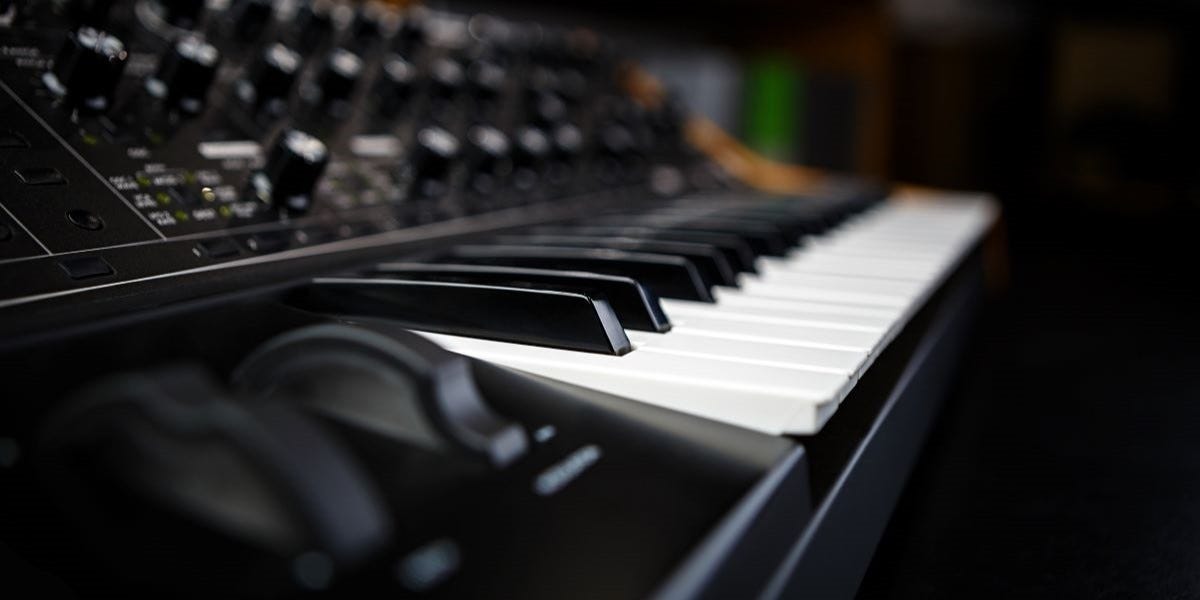
A synthesizer is an electronic musical instrument that creates sound by manipulating electrical signals. Many synths look like digital pianos with keyboards, while others are standalone signal-messer-uppers that look like a box with lots of little knobs and cables.
It’s easy to confuse synths with keyboards, workstations, or digital pianos. But one of the main characteristics that set synths apart from their keyed counterparts, or any other instrument really, is their ability to change and shape sound with oscillators, modulators, and carriers. Don’t worry; we’ll get into what those are in a minute.
Synthesizers are used in nearly every genre of music. Obviously, they play a big role in electronic music, but they’re also commonly used in rock, country, pop, and basically any other type of music you can think of. Because of their nearly limitless range of sounds, they are almost like the Swiss Army Knife of music!
In the beginning...
Many people think that the first synthesizer was made in the ‘20s. However, we’ll go back a bit before that to days of the cowboys and saloons when a man by the name of Thaddeus Cahill invented a gigantic electro-mechanical musical instrument named the ‘’Telharmonium’’, also known as the ‘‘Dynamophone’’. The patent was approved in 1897, and the instrument was first demonstrated in 1902.
To give you a picture of what this bad boy looked like, it weighed about seven tons and took up most of a room. It used vacuum tubes designed for organs to craft its sound.
Initially this noisy instrument was meant to play music for people using telephone lines. However, it turned out to be more of a problem because it would interfere with signals beyond just the telephone lines. People reported hearing strange electronic music all over the place!
Even though Cahill would try to improve his invention with two more models, it proved to be a high-cost risk with not much of a reward in terms of revenue. By 1914, the company was declared unsuccessful.
So, what was the first “successful” synthesizer? It's one of the most unique instruments around, and it’s still being used today! It’s also the only instrument you play without touching it. Fun Fact! Of course, we’re talking about the Theremin.
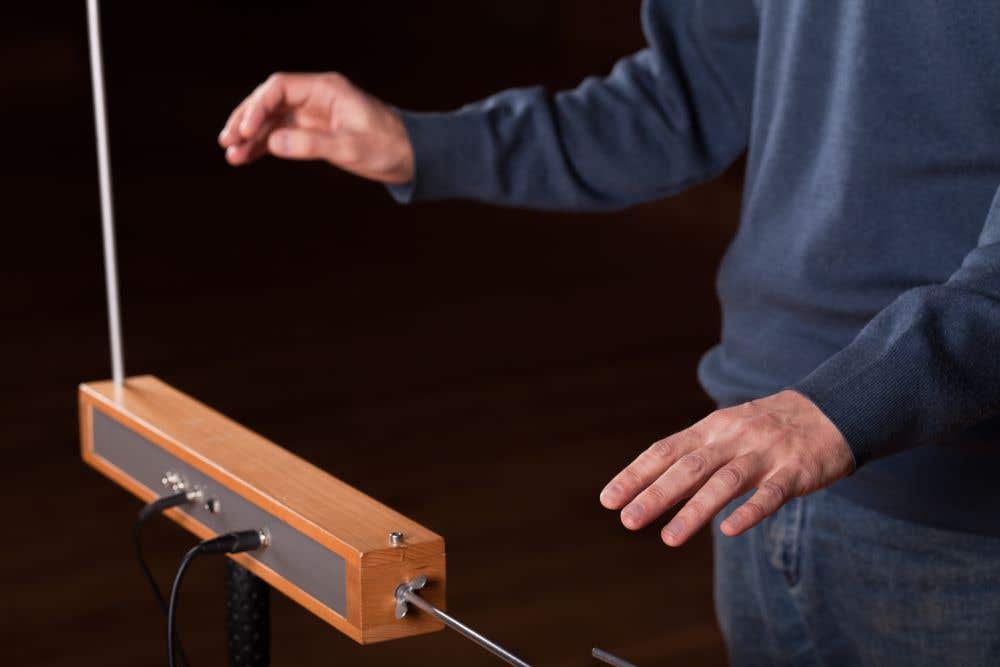
The Theremin was built roughly around 1930 by a Russian physicist named Lev Sergeyevich Termen, also known as Leon Theremin. You might be asking what this instrument sounds like, and the best answer I can give is… “spooky.”
With the Theremin, you change the pitch by moving your hand closer and farther from the vertical antennae, and you change the volume by moving your hand horizontally around the horizontal antennae. Although its unique sound was somewhat limiting, the Theremin was a big step in creating electronic musical sounds that would later influence manufacturers to push instrument development into the future.
The grandfather of synthesizers
After Thaddeus Cahill and Leon Theremin showed the world that you could make music with signal manipulation, instrument manufacturers were off to the races! One of the first “modern” (kinda...) synthesizers came from Radio Corporation of America (RCA).
In 1955, Harry Olson and Herbert Belar developed the RCA Mark I synthesizer at their laboratories in Princeton, New Jersey, which was originally planned to auto-generate pop “hits” and to cut the costs of recording sessions for composers. If this machine could produce arrangements without needing to hire an orchestra or musician, why not avoid the expenses? The operator would feed the notes via binary code on a sheet of paper into the typewriter-looking machine. High-tech, right!?
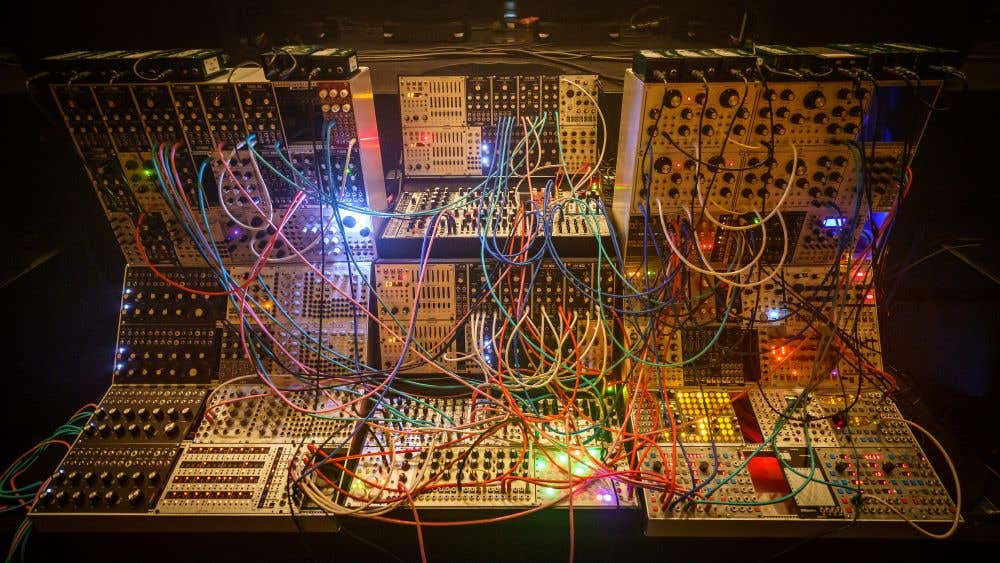
P.S. The synth pictured above is not the RCA Mark I. The Mark I was much bigger! To give you an idea of how big this machine looked, it took up the entire room at Columbia University’s Computer Music Center. With a bank of 12 oscillator circuits, this generated the 12 basic tones of the musical scale in which it could arrange and shape these notes in any pattern or sequence. These sounds could be altered by the additions of high-pass filters, low-pass filters, envelope filters, modulators, frequency dividers and resonators.
In 1957, the RCA corporation then came out with the RCA Mark II. It had the same functions and sounds as the Mark I, but it had twice as many oscillators to give the composer more flexibility using pitches of notes.
You can still see the RCA Mark II Sound Synthesizer (nicknamed Victor) at the Columbia Computer Music Center in New York City.
Of course this is far from the synthesizers you’ll see today; it was a significant achievement and foreshadowing of what was to come later on in the music technology world.
Synthesizers go commercial

Even if you’re not a synth player, you’re probably familiar with the Moog synthesizer. If there was one synthesizer that set in motion and served as a template for later synthesizers, it would be this one.
In 1964, Robert Moog created the first voltage-controlled synthesizer which utilized separate modules to shape the sounds via patch cables. Using a filter known as the “ladder” filter, waveforms could be transformed from sine to square, triangle, and sawtooth waves.
This was one of the first synthesizers that gave the user the ability to use modulation, which is essentially a process by which a sound can be changed by utilizing the filter cutoff, volume, pitch, or any other parameters that affect the sound. Basically, you can make unlimited sounds.
Unlike the synths of yesteryear, the Moog modular synthesizer wasn’t a ”one-and-done" kind of deal. Moog mass produced these synths! Of course, they were expensive, but they brought unlimited sound creation to the masses.
Bands and artists like Wendy Carlos, The Beatles, Rolling Stones, Donna Summers, ELP, and many more got their hands on these early Moog modular synthesizers and transformed the entire music industry as we knew it.
By 1970, Moog continued off of the success of their modular synthesizer and produced the Minimoog. Moog took all the groundbreaking features from the modular synth and packed it in a portable, stage-ready design. Since the power supply was something that wasn’t completely stabilized, this unintentionally created the synthesizer’s warm and rich sound. The voltage-controlled filter allowed users to create funky bass snarls to spacey whistle-like lead tones.
Another feature on the Minimoog that influenced other synthesizers that would come later is the pitch bend and modulation wheel. As you move the wheel, you can move your pitch higher or lower by an octave. Modulation Wheels, or sometimes referred to as “mod wheels,” are used to add expression and modulate the sound of your synthesizer in real time. They’re great for adding vibrato or even controlling the speed of a rotary effect.
Why is modulation important in synthesizers? Well, without the movement applied to sounds, everything would just sound boring after a while. Modulation effects add a greater dimension to the sound and allows for an expanded sense of dynamics in your creativity.
The first polyphonic synthesizers
In 1972, ARP introduced the Odyssey Model 2800 (also known as Odyssey Mk I) as an answer to the Moog synthesizer. The Odyssey was even more compact and lighter than the Minimoog. As a two-oscillator synthesizer, this was one of the first synths that could play more than two notes at the same time, which foreshadowed what would become polyphonic synthesizers.
When it came to producing sounds, the Odyssey synthesizer used a two-pole voltage-controlled filter design, which had a tinny-but-smooth sound. The filter options allowed you to shape the sound of the waveform as it was played.
Taking things to the next level, in 1977, American engineer Dave Smith quit his full-time job to work on an idea to create a programmable synthesizer. His experience working with microprocessors gave him the ability to combine processors with a synthesizer chip. Smith teamed up with another engineer named John Bowen to create the Prophet-10, a ten-voice polyphonic synthesizer. Unfortunately, the ten voices proved to be unstable with tuning and overheating issues, so Smith reduced the instrument to five voices. These models shipped to consumers later in 1978 as the Prophet-5.
What made this model special is that theProphet-5 had patch memory, which means users didn’t need to program anything on the fly. They could store a desired sound right in the patch settings. This changed the music world by giving synthesizers a “standard set” of sounds used by the industry.
Breaking the chord: Rise of the arpeggiator
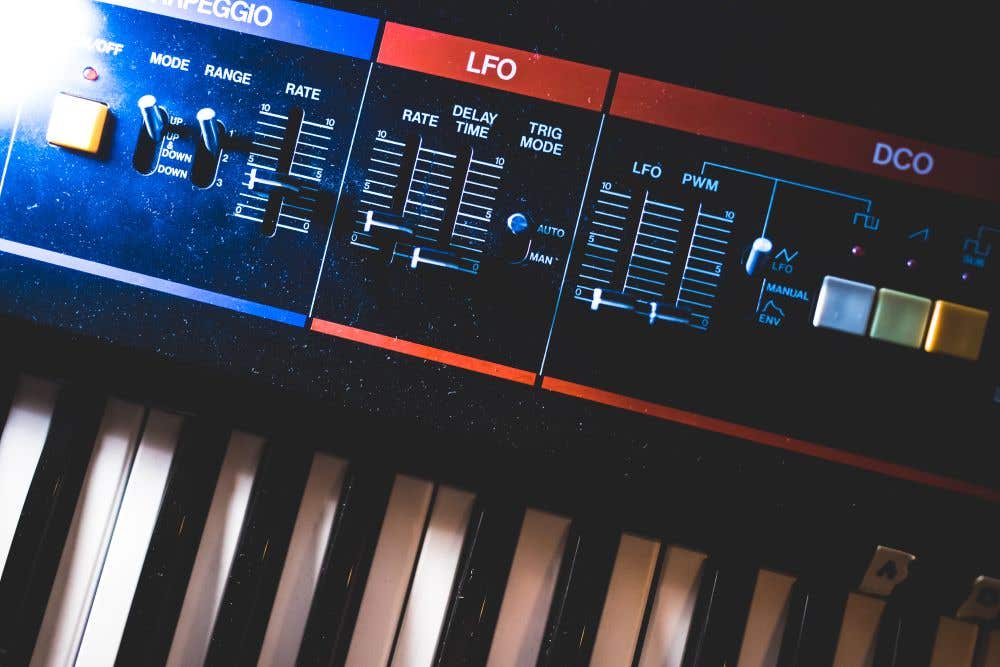
The Prophet-5 — along with the Roland Jupiter-4, which we’ll get to next — was also one of the first synthesizers to incorporate arpeggiators. Arpeggiators take any chord and arrange the notes in a sequence. Instead of the notes in the chord being played simultaneously, they’re set into motion based on a pattern.
Pete Townshend made great use of an arpeggiator in some of the most popular rock songs in history, like “Baba O’Riley” and “Won’t Get Fooled Again”, just to name a couple. You’ll know it when you hear it!
The Prophet-5 and all its groundbreaking features have been used by The Cars, Kraftwerk, Duran Duran, Depeche Mode, Talking Heads, Peter Gabriel, Genesis, INXS, Phil Collins, Hall & Oates, Steely Dan, Pink Floyd, the Eurythmics, George Duke, and many more. It was a good indicator of how the future of synthesizers could change and impact the artistry of music.
Also in 1977, Roland introduced the Jupiter-4. It was a polyphonic synthesizer that had a solid, warm, and meaty sound, which was perfect for fattening song mixes. The Jupiter-4 also had an integrated arpeggiator, which helped launch it to the forefront of music technology at the time.
The biggest addition to the Jupiter-4 was the chorus effect that helped produce lush and pillowy textures. Because of its lower cost, the Jupiter-4 got into the hands of a lot of new-wave and electronic musicians. Artists and musicians like Vangelis, Gary Numan, David Bowie, Paul Davis, Men at Work, Depeche Mode, and Duran Duran are only a small selection of the many who used the Jupiter-4 on their records.
Analog goes digital
By the late 70s, synthesizers became more prominent and were taking technology to greater heights. The warm sounds of analog synths were becoming more mainstream, but a new sound was just emerging... The turn of the decade brought about a transition from the old age of analog to the high-tech years of digital.
When we talk about technology being ahead of its time, the PPG Wave 2 synthesizer is definitely one example. An engineer named Wolfgang Palm decided to combine the warmth of analog filters and Voltage Control Amplifiers (VCAs) into a wave table that could store and change between various sounding waveforms, providing a glassy and digitized sound that was very distinct in nature.
Instead of using analog oscillators as a sound source, it used digital sound samples. A total of 64 waves combined to form a “wavetable.” The wavetable allowed the user to load descriptions of waveforms and reproduce them, adjusting the playback and controlling the pitch. Essentially it could sample the waveforms and adjust the start and end of one so that it could be repeated at a constant. This gave players the ability to experiment and use many patches of sounds as a template to use for their music.
Of course, the PPG kept many of the classic offerings from synths of yesteryear, including an arpeggiator, filter, and ADSR envelope generators (Attack, Decay, Sustain, Release).
The PPG Wave was integral to commercial music of the 80s. It was commonly used by major bands, including Tangerine Dream, Rush, Sammy Hagar, SAGA, Depeche Mode, and many others. This was the synthesizer that bridged the gap between weird computer-based processors and analog-loving musicians.
While most synthesizers were chasing warm analog sounds, in 1983 Yamaha moved towards brighter and more complex digital sounds with the Yamaha DX7. One of the highlights of the DX7 was the new method of frequency modulation (FM) synthesis, allowing it to create percussive, metallic, and acoustic sounds. Musicians could also customize and store patches, which gave producers and working musicians the freedom to decorate their records with an array of futuristic sounds.
Since the technology was so new at the time, it was quite complex to store patches. Unless you were Brian Eno, nobody really designed their presets from scratch. Of course, nowadays custom presets may not seem like anything out of the ordinary, but back in the 80s the DX7 was way ahead of its time.
If there was one synthesizer that defined the 80s, I think it’s safe to say that the Yamaha DX7 takes the lead in this poll. Musicians like Tears for Fears, Kenny Loggins, Whitney Houston, Tina Turner, Phil Collins, and Herbie Hancock are just a few out of the many that adopted the use of this amazing technology during that era of music.
The modern era of synthesizers
The Korg Wavestation emerged in the early 1990s and is considered by the 1995 Keyboard Magazine as one of the “20 Instruments that Shook the World.” Unlike previous synthesizers, the Korg Wavestation had the ability to generate complex, lush timbres, and rhythmical sequences that made pressing a single key sound like an entire soundtrack.
Okay so you’re probably wondering how and why this is any different from any of the other synthesizers that we previously mentioned… right? The Wavestation combined the processes of wave sequencing and vector synthesis, essentially mixing and morphing between wave forms and audio samples, giving it an entirely new and unique sound.
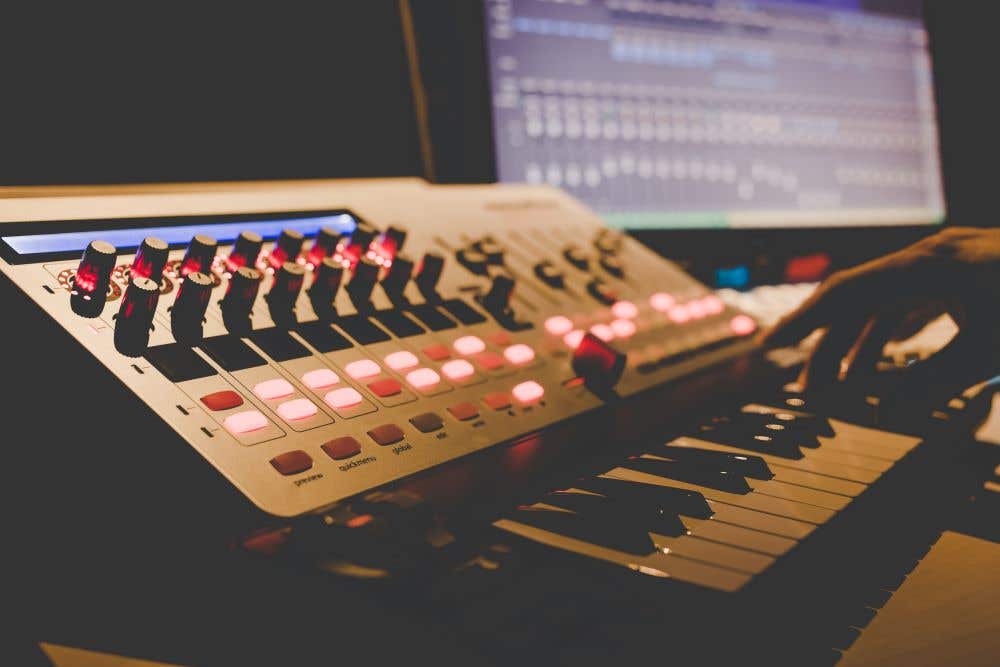
Today, there are numerous synthesizers that give you endless options from hundreds of sound banks. You can easily and quickly customize your own sounds and program them into your own favorite presets.
The same goes for software synthesizers as well, which are used via your digital audio workstation (DAW). Now you can run patches from your computer, download, and adjust new presets depending on what software you’re playing through, allowing for an infinite expansion of sound possibilities.
It's incredible how synthesizers have changed from huge walls of machines to portable keyboards and even non-physical software applications that can store and play thousands of sounds. But it does make you wonder, what could be next in the world of synthesizers...?
The timeline of synth development continues
With every generation of synthesizers, new features unfold that are designed to boost your creativity. From the early archaic models of synthesizers to the latest digital sounds, you can make your own mark in the synthesizer timeline here at AMS.
Want to start your very own synthesizer journey? We’re more than happy to offer some advice on what synth might suit your needs. Give us a call at 800-458-4076 and talk to our friendly Customer Service experts. They're all experienced musicians, so feel free to grill them all about modulators, envelopes, arpeggiators, patch bays, or any other fancy synth terminology you can think of. Together, we’ll find the perfect synth for your style. Now get out there and make some sounds!