Banner Illustrated by Michael Telewiak
If you’ve been performing live music, then you’ve likely at least heard of direct boxes, often called a “DI box” (which stands for “direct inject”) or just “DI” for short. While they’re common in the live audio engineering world, it’s also likely that many people have never used one before.
Don’t worry if you haven’t; that’s what we’re going to talk about! So, what exactly is a direct box, and how can it help you as a musician and creator?
Direct Boxes: An Overview
Simply put, a direct box is a device that takes unbalanced instrument-level or line-level signal of higher impedance and converts it to balanced mic-level signal of lower impedance. This allows for a more stable direct connection over longer cable runs, as balanced XLR cables can stretch for over 100 feet while still eliminating noise and minimizing any loss of signal.
The invention of the first DI box was credited to Dr. Edward Wolfrum in the late 1950s. It was known as the “Wolfbox,” and it was born out of necessity, just as many other audio devices in this era had been. Outfitting a recording space with microphones cost a lot of money, so Wolfrum engineered a solution to convert the signal directly from instruments like electric guitar and bass into one that was similar in strength to that used by a microphone. Then they could all go into a multi-track mixing console, and boom! You have yourself a microphone-free way to record high-quality, balanced audio.
While they were a huge breakthrough, those early DI boxes, especially passive unpowered models with broadcast or telephone-style transformers, sometimes struggled to supply the mixing console (and an amp simultaneously, if it had that capability) with enough signal. This meant a weaker, thinner, and duller sound that could be particularly troublesome to balance. Solving that issue became a two-fold process: First, creating newer powered "active" DIs that increased impedance and amplified the signal. And second, engineering more powerful and efficient transformers in "passive" DIs that wouldn’t "load down" the signal to maintain a full, authentic sound.
Those very old-school broadcast transformers in the first DIs rated around 600 ohms. Today’s passive DIs can register over 100,000 ohms!
Just a bit of an improvement, wouldn’t you say?
DI boxes are incredibly valuable pieces to have in both a recording and live sound toolkit to get the most accurate signal possible.
Different Types of Direct Boxes
There are two main types of direct boxes, active and passive. While they both perform the same general function, each brings a distinct character and special set of use cases to performances.

Passive DI Boxes
Passive DI boxes don’t require any power, are straightforward to use, and are incredibly versatile. That being said, passive boxes are best suited for active instruments and devices with a stronger signal output, such as electric basses with their own built-in active preamp systems, digital keyboards, samplers, computers, and outputs from an audio interface. Because there’s no need for power, passive DIs can reduce the likelihood of introducing any extra noise in the system.
It is important to note that certain instruments with passive electronics, vintage pickups, and older consumer devices that put out weaker amounts of signal can end up sounding thin and hollow when run through a passive DI. You’ll need to spend time dialing in the proper gain and presence adjustments at the mixer or interface level to make up for that weakness. Even so, an active DI is still likely a better fit here, which leads us to…
Active DI Boxes
Active DI boxes include a preamp that helps boost the signal and provides more headroom to make it easier to dial in the proper gain staging in an audio mix. They require an external power supply or 48V phantom power from a mixing console or audio interface.
Active DIs work very well with unpowered instruments that need some extra signal support, such as electric guitars, acoustic-electric guitars, passive electric basses without a built-in active preamp system, and other orchestral string instruments with piezo or magnetic pickups.
Many active DIs are going to be “sonically neutral,” but there are also models designed to work with specific instruments or add certain types of vintage coloring based on the preamps they contain.
Important Features of a Direct Box
There are a wide variety of direct boxes with different feature sets at different price points. Here are some of the most common controls that you may come across when working with a DI:
Pad Switch
A pad switch reduces the sensitivity of the input signal to prevent overloading. If an instrument or device produces a particular hot signal, engaging the “Pad” switch will make it more manageable.

High-Pass Filter
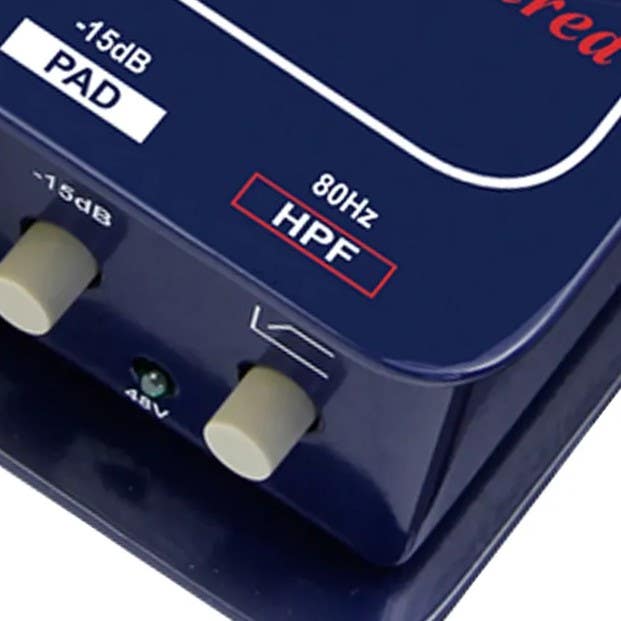
A high-pass filter switch or knob, when activated, removes the lowest frequencies (think below 100Hz) by allowing all the higher frequencies to “pass through.” This is particularly useful in eliminating noise and stray, unnecessary low frequencies from guitars and other stringed instruments that don’t regularly produce those frequencies anyways. This results in a cleaner, more focused output sound.
Ground-Lift Switch
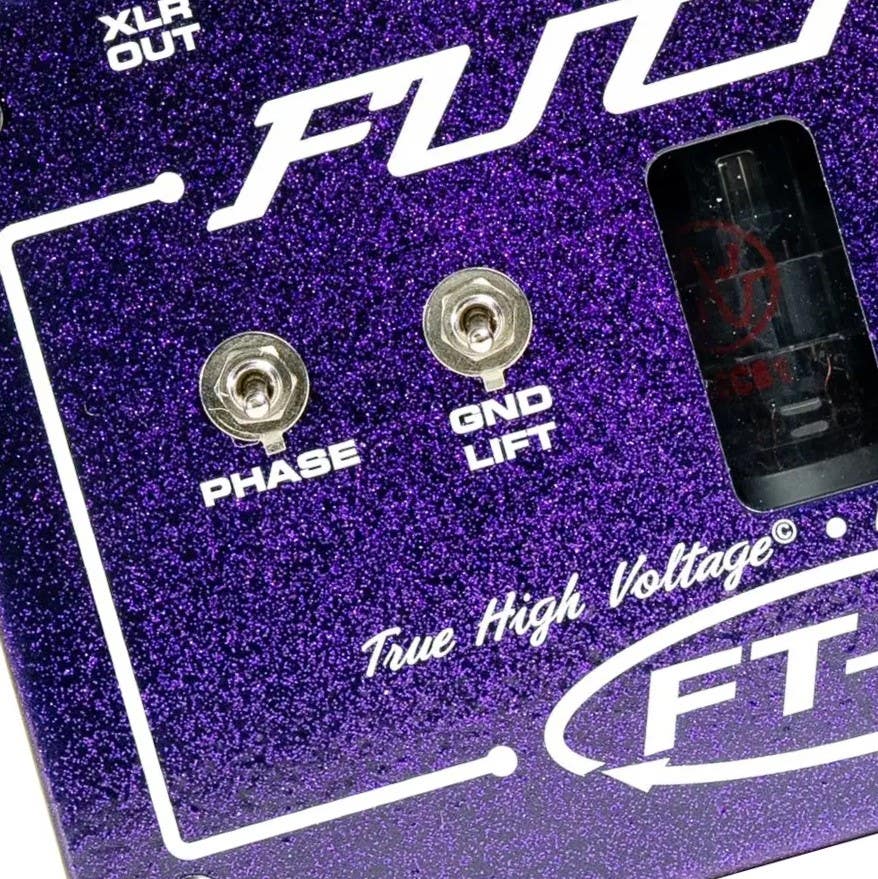
Many DI box models have a button that will reduce hum and noise caused by ground loops. A ground loop is heard through speakers as a hum of low frequency noise (50-80 hZ) that’s caused when different pieces of audio equipment are plugged into different AC outlets and connected together with signal cables (an XLR cable, for example). A ground-lift switch can help to safely reduce any noise contribution in this manner generated from the instrument or device connected to the DI box.
How to Use Direct Boxes for Live Performance
Guitar, bass, and keyboard use 1/4” TS cables (instrument cables) to connect directly to an amplifier, which is the most common way to play live. If the sound engineer needs more sound, then they will simply mic the amps directly and add more signal to the venue’s PA system.
However, if you don’t have an instrument amp, or circumstances are preventing you from using them effectively, this is where a direct box can jump in and save the day.
In certain venues, limited space can be a concern. There just may not be enough room on the stage to hold a bunch of amplifiers. Using direct boxes to send just the right amount to various stage monitors can provide a similar sound and feel on stage as if you were using amps.
In my experience as a both a sound engineer and audience member, many performers have a tendency to turn the volume up on their amps as the show goes on. It could be to hear themselves better on stage, and other times it’s to cut loose because of the steadily growing energy of the crowd. Whatever the justification, it’s a fact that everything usually gets louder over time. I can see all of you nodding in agreement… DI boxes can help the audio engineer keep things under control.
With a DI box, you can eliminate amps altogether, which allows the engineer to balance everything in an intimate room, sending just the right amount to stage monitors so everyone can hear without making things too loud.
Also, many acoustic-electric guitar and keyboard players often play without any form of external amplification. In many situations, guitarists will play unplugged and keyboardists will opt to simply use their instrument’s built-in speakers, so it’s understandable that they don’t have extra equipment on hand all the time. But it can be problematic if they show up to a space as part of a larger ensemble with no way to take their volume beyond a certain point. Having a direct box handy will solve that issue by being able to run their instrument to the mixing console, boost their volume, and bring better balance to the overall mix.
How to Use Direct Boxes in The Studio

Direct boxes aren’t only used in live performance situations; they’re incredibly helpful tools in the recording studio, too!
In addition to capturing your sound from mic’ing your instrument amp, you can simultaneously record a clean signal right from your instrument using a direct box.
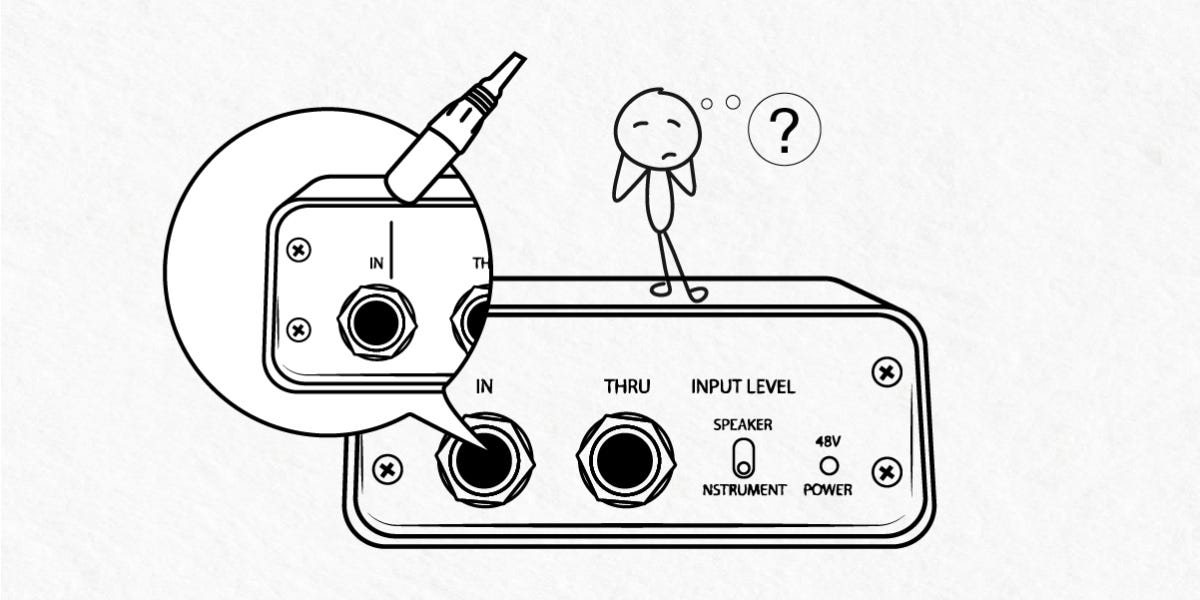
Simply connect your instrument to the direct box “INPUT” port and run your XLR from the direct box “OUTPUT” to a channel on a mixer or audio interface. Then run a second instrument cable from the direct box “THRU” port to the input channel on your mic’ed amplifier. And voila, you have two separate signals for recording! This is how we record a lot of gear in the AMS Studio for our product videos and jams.
Now, the possibilities really open up: You can blend different combinations of the two signals to dial in your preferred sound, have an extra track to incorporate additional digital effects on top, create phase-style double layers, reamp stuff later, and a lot more.
Using a direct box in this manner with an electric bass guitar assures that you’re getting the full range of frequency in your mix, both in recording and live situations. With many mics, sometimes the low bass range (under 100 hZ) can be a little thin, so getting that second raw signal and EQ’ing it down to focus on those lowest harmonics is an excellent way to supplement the sonic color from the amplifier with extra low-end presence.
Direct Boxes for DJ Equipment, Computers, and Sound-Generating Devices
More and more people are incorporating laptop computers, phones, DJ hardware, and both modern and vintage sound-generating devices into live music. Items like CD and cassette players use consumer line-level RCA cables, new samplers use pro line-level 1/4" cables, and computers and phones have 3.5mm headphone outputs (either directly or through an adapter like a USB-C to 3.5mm cable).
The question is, how do you securely connect these types of devices to a venue PA system easily?
With a DI box, of course! That way you can position the gear anywhere on stage and easily run XLR cables to their destination.
There are great multi-use DI boxes that have 3.5mm, 1/4” TS, and RCA inputs, which covers the entire range of devices. If you’re a performer that wants to use equipment like this regularly or a sound engineer that works in a setting where anyone at any time might plop a computer in front of you and say, “I have something I need to play from this, can you make it happen?” a box like the Radial Trim Two Passive DI is a wonderful investment.
It’s also worth picking up a couple of cables to cover whatever you need to amplify:
- 3.5mm stereo to 1/4" TS left and right interconnect cable
- RCA left and right to 1/4” TS left and right interconnect cable,
- Dual 1/4” TS to same
These are all nice to have in your toolbox. And by being prepared, you will also make an engineer’s day if you need to use other DI boxes and equipment at a live venue or recording space.
Go “Direct”-ly to AMS for the Best DI Boxes!
DIs are incredibly handy tools and can add a whole new dimension to your recordings and live shows. Instrumentalists, DJs, producers, and engineers alike can benefit heavily from adding them to your toolkit.
When you’re ready to expand your possibilities, American Musical Supply is here! We’re stocked with models from the big names in audio, and our 0% interest payment plans are the easiest way to bundle a collection of them together and spread out your payments. Grab a DI for yourself and see what it can bring to your live sound or studio experience.