

The concept of a tremolo bridge or tailpiece has been around since the late 1920’s when Doc Kauffman invented his “Vibrola” system for archtop guitars and lap steel. All the subsequent designs share the same principle: Change string tension to lower or raise pitch by pushing or pulling the tremolo arm, or the “whammy bar” as it has come to be known, respectively and rocking the string anchor.
It all sounds very complicated, but it’s really just a few springs and a metal bar. Here’s everything you need to know about what a whammy bar does and how to use it.
The Guitar Tremolo System, Explained
There are several types of guitar tremolo systems. And while they all look different, they all share the same goal: manipulate the string tension and return (hopefully) to the exact pitch.
The basic idea is that the bridge works like a fulcrum. Push down on the lever (or “whammy bar”) and the bridge shifts forward, loosening string tension and dropping the pitch. When you let go of the tremolo bar, springs either in the body of the guitar or on the tailpiece (depending on which system you use) pull the bridge back to standard position and your guitar back in tune. It’s essentially a balancing act between the strings and the springs, which can make it somewhat annoying to change your strings.
Types of Guitar Tremolo Systems
Now that you know how a “whammy bar” works, let’s take a look at the various types of guitar tremolo systems.
Tremolo Tailpiece (Bigsby)
The first guitar tremolo system was the tremolo tailpiece. They were originally designed for archtop guitars but they eventually made their way over to solid-body instruments.
Just like with a regular hard tailpiece, the strings are anchored to a metal tailpiece that’s fixed to the top of the guitar. However, tremolo tailpieces have a spring that allows the bridge to rotate when the player depresses the tremolo bar. When the bridge rotates forward, the string tension decreases, along with the pitch. Release the tremolo arm, and the spring returns the string tension and the pitch to neutral.
The tremolo tailpiece was invented in 1948 by Paul Bigsby, a retired motorcycle racer. These were a big feature for Gibson and especially Gretsch guitars, which owned the company for a time. The tailpiece tremolo is only designed to lower the pitch and is notably difficult to keep in tune and to restring. They also provide a great vintage aesthetic that many players enjoy.
Floating Tremolo

Leo Fender’s floating tremolo uses a fulcrum design hinging on studs or screws in the top of the body. On the back of the bridge, a block extends down to a set of springs and an adjustable claw, letting you raise and lower the pitch of the note by pushing down or pulling up on the whammy bar.
A set of springs in the body controls the amount of float and can be tightened to eliminate it altogether. Several methods of limiting and fixing or “blocking” the travel of the bridge have been invented over the years. I set up my Stratocaster so the back pull will raise the note by a perfect whole note when the bridge is stopped by the body.
Locking Tremolo (Floyd Rose)
An iconic locking tremolo system was patented by Floyd Rose in 1979. This differs from Fender’s idea by using machined saddles that at are clamped into the nut and bridge, so they won’t shift with tension changes. The locking system eliminates tuning issues and allows for the now-infamous “dive bomb” to return at perfect pitch.
The system was featured on Ibanez guitars and gained popularity in the signature models they built in collaboration with notable artists Steve Vai and Joe Satriani. Eddie Van Halen used a Floyd Rose system in his iconic Frankenstein guitar.
Original or “authentic” system carry the patent number on the face of the bridge, while the more cost-effective systems are referred to as “Licensed by Floyd Rose”.
Digital Whammy Bar

Digital pitch shifting can be used as a tremolo effect as well a transposition device. It’s essentially a guitar effects pedal that shifts your pitch up or down, rather than doing it the old-fashioned way with springs and physics.
Digitech introduced the Whammy Pedal in 1989. Allowing for shift of up to two octaves up or down, it was immediately embraced by players and heavily featured by Tom Morello of Rage Against the Machine and Ed O’Brien of Radiohead, among others.
An interesting approach is The Gamechanger Audio Bigsby pedal, paying homage to the old Bigsby design.
B-G Benders


String benders allow the player to only bend one or two strings without disturbing the rest. It’s like a whammy bar for individual strings. One of the most successful designs by Gene Parsons and Clarence White was incorporated into a Fender Telecaster, now discontinued. In the heyday of country western swing bands, the bandleader could pocket a little extra money if the guitar player could also mimic the pedal steel parts, allowing the band to be one member smaller.
Types of Guitars with Whammy Bars
Typically set up with tremolo tailpiece, two humbucking pickups, many Archtop guitars sport tremolo tailpieces, especially Gretsch guitars. They can be comfortable in many musical settings but more commonly Rockabilly and Jazz/Swing. Due to their hollow body design, they are more susceptible to feedback at volume so might be a bit of a handful on a loud stage.
Leo Fender was issued a US patent on the “Tremolo Device for Stringed Instruments” he designed for the Fender Stratocaster in 1956. In continuous production and refinement since then, the Strat has been the guitar of choice for countless guitarists in all genres, Jimi Hendrix and Eric Clapton to name a couple. Since it’s a bolt-together design, it was easy to modify and spawned a huge aftermarket parts industry. Modern Stratocasters still come with “whammy bars” based on the original tremolo design. It even inspired a new class of guitar…
The Superstrat, AKA “Shredder.” came about in the late ‘70s as players began modifying their Stratocasters with humbucking pickups and installing locking tremolo systems by Floyd Rose and Kahler. Builders like Ibanez, Kramer, Jackson, Charvel, ESP and many others quickly recognized the trend and began offering hot-rodded versions of the Strat as well as other more extreme body shapes. These guitars usually feature very eye-catching vivid colors and graphics, as well as locking tremolo systems designed for insane dive bombs.
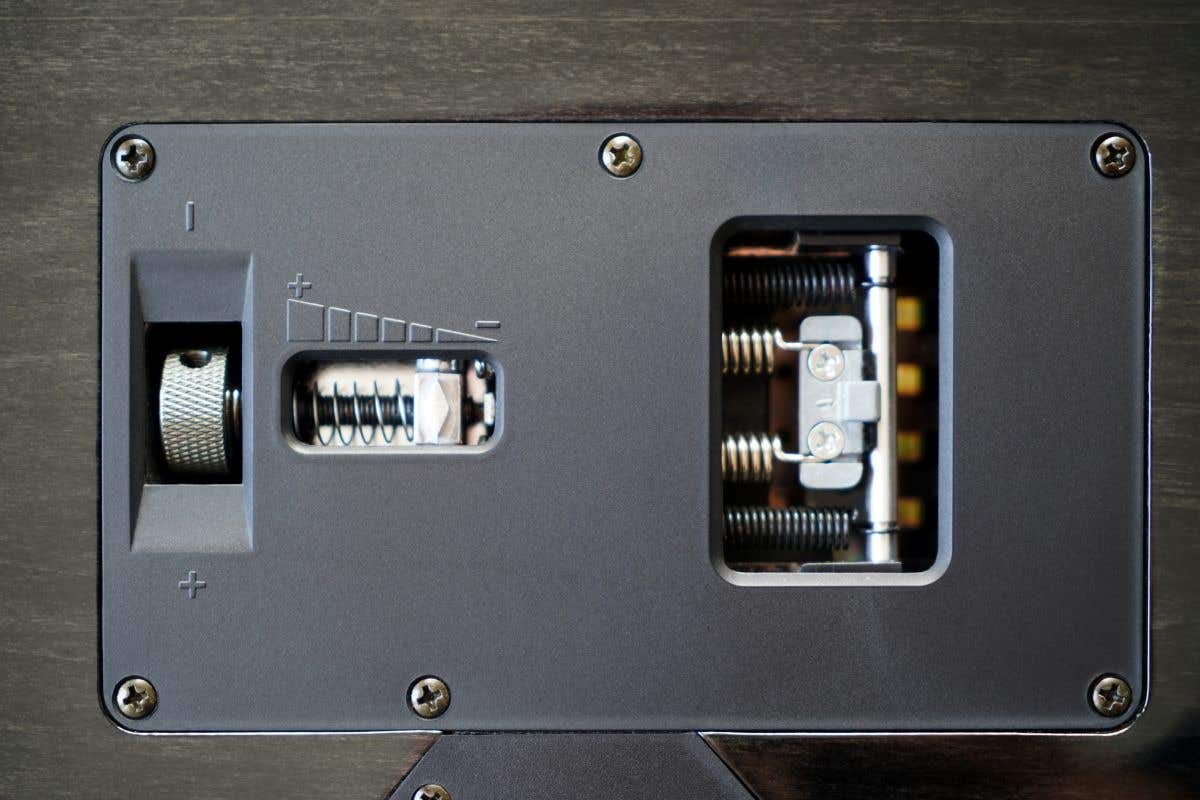
This is what the underside of a guitar with a tremolo system looks like (except tremolo tailpiece).
Keep Calm and "Whammy" On
At AMS, you can find a huge selection of tremolo-equipped guitars to suit every dive bomb, vibrato, and bend you want to play. These instruments can be a little genre-specific, but there’s no rule about what you might do with them. Plus, rules are made to be broken anyway.
If you’ve thought about adding a new guitar to your collection, check out all the awesome electric guitars at AMS — and don’t forget about our easy 0% interest payment plans, VERY fast and free shipping, and industry-best 45-day return policy. If you want to talk with an actual whammy bar operator, call our gear experts at 800-458-4076.
Thanks for taking some time to read this, and thanks for making some music happen in the world! Stay calm and whammy on.