Every time you stream a song, make a phone call, power up your guitar effects processor, or adjust your digital mixer settings, you're experiencing the wonderful workings of digital signal processing (DSP). Yet most people have no idea what DSP actually does or why it quietly powers so much of our modern world. If you've ever wondered how your smartphone can clean up a noisy call or how your favorite musician gets that perfect reverb effect, DSP is the invisible wizard behind the curtain.
Understanding DSP isn't just for engineers and tech enthusiasts anymore. Grasping the basics of digital signal processing will help you make better decisions about the tools you use every day.
What Is DSP?
Digital signal processing is the mathematical manipulation of information signals to modify or improve them in some way. Basically, it transforms the analog world around us into the digital realm where computers can work their magic. Think of it as the universal translator between the physical waves of sound, light, and radio signals and the binary language that digital devices understand. Without DSP, your digital music would sound like a robot having an existential crisis, and video calls would be about as clear as trying to have a conversation underwater.
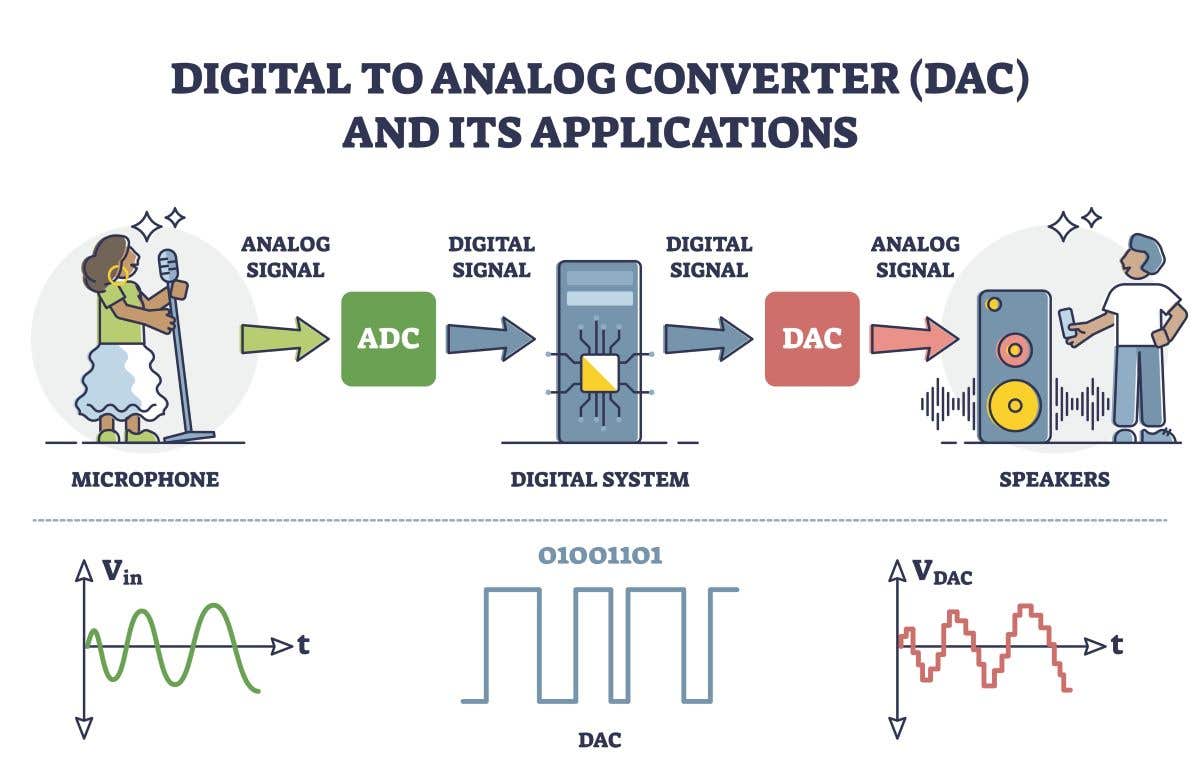
The process begins when analog signals from the physical world encounter a digital system. These signals might be the vibrations from your voice, the electromagnetic waves carrying a radio broadcast, or the light patterns hitting a camera sensor. DSP systems capture these analog signals and transform them into streams of numbers that represent the original information with remarkable precision.
Once in digital form, these signals can be manipulated in ways that analog processing alone simply can’t do. You can remove specific frequencies, add effects, compress data for efficient storage, or enhance particular characteristics while leaving others completely untouched. The processed digital signal can then be converted back to analog form for speakers, displays, or other output devices.
Modern DSP relies heavily on specialized processors and algorithms designed to handle these operations in the most efficient manner. These processors can perform millions of calculations per second, enabling real-time processing that keeps up with live audio, video, and other time-sensitive applications.
Why DSP Matters and Why Should You Care
Digital signal processing has revolutionized how we interact with technology by making devices smarter, more efficient, and more capable than any of their analog predecessors. The precision and flexibility of DSP allow for applications that simply weren't possible before, which is especially helpful in the musical world.
Consider noise cancellation in modern headphones. DSP analyzes incoming audio signals, identifies unwanted background noise patterns, and generates precise inverse signals to cancel out the unwanted sounds. This process happens in real-time, adapting to changing acoustic environments faster than you can notice.
Recording studios now rely on digital effects processors that can simulate vintage equipment, create impossible acoustic spaces, and provide surgical precision in audio editing. Musicians can carry entire studios in their laptops, with DSP-powered software instruments that rival their hardware counterparts. Pretty cool right?
Beyond entertainment, DSP plays crucial roles in medical devices, automotive systems, telecommunications, and countless other applications. MRI machines use DSP to convert radio frequency signals into detailed images of the human body. DSP enables more efficient use of radio signals, allows for higher-quality audio and video streaming with less bandwidth, and makes possible the miniaturization of complex electronic devices.
How Does DSP Work?
Understanding how digital signal processing works requires looking at its key components and processes. While the mathematics can get complex, the basic concepts are actually pretty straightforward.
- Sampling forms the foundation of all digital signal processing. This process converts continuous analog signals into digital values by taking measurements at intervals. The sampling rate determines how often these measurements occur, even up to tens of thousands of times per second for audio applications. The quality of sampling depends heavily on the sampling rate and bit depth. Higher sampling rates capture more detail but require more processing power and storage space.
- Filtering allows DSP systems to selectively modify different frequency components of a signal. Digital filters can clear out unwanted noise, isolate specific frequency ranges, or shape the overall frequency response of a system. Common filter types include low-pass filters that remove high frequencies, high-pass filters that eliminate low frequencies, and band-pass filters that allow only specific frequency ranges to pass through.
- Amplifying involves mathematical multiplication of signal values rather than the voltage amplification used in analog systems. This approach provides precise control over gain levels and enables complex dynamics processing like compression and limiting without the distortion artifacts common in analog systems.
- Converting signals back to analog form completes the DSP chain. Digital-to-analog converters reconstruct smooth analog signals from the processed digital data, allowing the results to drive speakers, displays, or other analog devices.
The Future of DSP
Digital signal processing is continuing to evolve rapidly, driven by advances in processing power, algorithm development, and new application areas. Machine learning and artificial intelligence are increasingly integrated with traditional DSP techniques, creating hybrid systems that can adapt and learn from their environment.
Real-time processing capabilities keep improving, enabling more complex algorithms to run on smaller, more power-efficient devices. This trend makes sophisticated DSP available in everything from hearing aids and smart home devices to other super-cool musical gear like pedal-sized modelers and real-time auto mixing.
Best DSP-Powered Products and Top Brands
The professional audio world showcases some of the most impressive DSP implementations available today. Yamaha's digital mixing consoles like the CL series offer comprehensive DSP-powered processing including dynamics, EQ, and effects processing for dozens of channels simultaneously.
For synthesizers, companies like Eventide and Universal Audio have built reputations on exceptional DSP-powered effects processors. Their reverbs, delays, and modulation effects are considered industry standards for both live performance and studio recording.
Guitar modeling has been revolutionized by DSP technology. Brands like Line 6, Kemper, and Neural DSP create guitar processors that can recreate vintage amplifiers, speaker cabinets, and effects pedals with ease and convenience. These systems analyze the harmonic characteristics and dynamic response of classic gear, then recreate those qualities through sophisticated DSP algorithms.
PA system manufacturers like QSC and Meyer Sound integrate powerful DSP into their powered speakers, providing built-in crossovers, limiting, EQ, and room correction capabilities. These systems can automatically optimize their output for different acoustic environments and protect themselves from damage through intelligent processing.
Here are several types of DSP-powered music products that utilize this technology in such an exceptional way:
- Kemper Profiler PowerHead Guitar Amp Modeling Processor Powered Head
- Line 6 Helix Stadium
- Darkglass Anagram Bass Multi-Effects Unit
- Eventide H90 Harmonizer and Multi Effects Processor Pedal
- Yamaha TF3 Digital Mixer
- QSC K12.2 12" 2000 Watt Powered Speaker
- Universal Audio UAD 2 Satellite OCTO Core Thunderbolt 3 DSP Interface
Ultimately, DSP technology continues to push the boundaries of audio innovation, making it easier than ever to enjoy incredible sound quality in any environment.
Wrapping Up the Digital Revolution
It’s no doubt that digital signal processing is one of the most significant technological advances of the past century, quietly enabling much of the digital world that we now take for granted. From the music streaming on your phone to the GPS guiding your commute, DSP technology works behind the scenes to make modern life more convenient, entertaining, and connected.
Understanding DSP basics empowers you to make more informed decisions about audio equipment, appreciate the complexity behind seemingly simple digital devices, and recognize the sophisticated engineering that enables our connected world — and harness it all to create better tones, mixes, and music.
As DSP technology continues advancing, its applications will only become more diverse and impressive. It's a fascinating glimpse into how mathematics and engineering combine to enhance human experience through better sound, clearer communication, and smarter devices. You can reach out to us at our toll-free number 800-458-4075 if you have any more questions about gear that utilizes digital signal processing… The future awaits!