
When it comes to live sound equipment, it’s always the main foundation pieces, big expensive things, and shiny new trendy toys that get the bulk of the attention. But as in life, everything in your live sound rig really comes down to the little things. And in the music world, those are the important accessories that allow powerful instruments and gear that wows the crowd to function at their best — items that you don’t think as much about until the unexpected happens.
As a sound engineer who has learned about those little things the hard way, let me share some knowledge and recommendations so you can be prepared for anything and run your sound sessions more smoothly.
Here are six essentials you need to have in your sound toolbox. You can thank me later.
1. Power Supplies
When you’re running sound, quick and convenient access to clean power is an absolute must. That’s why power supplies, especially ones specifically designed to work with audio and media gear, are the first item on my list.
These sit on the ground and offer protection from surges and inconsistent power fluctuations, while also being able to accommodate a variety of plugs, power adapters, and space-hungry “wall warts.” Plus, nearly all of them have extra-long power cords stretching up to 25 feet, so you can reach outlets much easier. That means no more unreliable and potentially unsafe daisy-chaining of mismatched extension cords and power strips across the stage in a haphazard mess!
I have five of these in my rig: four of them positioned in each corner for the performance area and one for my own equipment. That way everybody has plenty of openings available for their gear. Sure… music clubs, bars, and restaurant spaces may provide their own power strips. But in my experience, most are just inexpensive consumer-grade models that have been repeatedly stepped on, had drinks spilled on them, and have been subjected to lots of wear and tear. Bringing your own will help you breathe easier.
2. Rackmount Power Conditioners
If you’re running a setup with rack pieces in a case — like digital stage boxes, wireless mics, in-ear monitors, mic preamps, headphone amps, other hardware processing — then you should also save at least one rack space in your case for a dedicated power supply. This ensures that all your equipment is connected to a safe, reliable power source, while also streamlining all the power cords to minimize stage clutter.

3. Plenty of Cables of All Different Lengths
This one seems obvious, but remember, you can never have too many XLR and 1/4” TRS (balanced) and TS (unbalanced) cables! When setting up for a music performance or audio project, cable management and positioning on stage is one of the first things you need to think about.
So how many cables do you need?
My rule of thumb is this: Picture a setup that would push your rig to max capacity and then count the number of input and output channels you use to make that happen. Factor in all your sources. Take that number and make sure you have that many cables. Repeat for each type of cable — XLR, 1/4" TRS, and so on.
Now ADD at least three or four extras as backups just in case something isn’t working or if an additional source is needed.
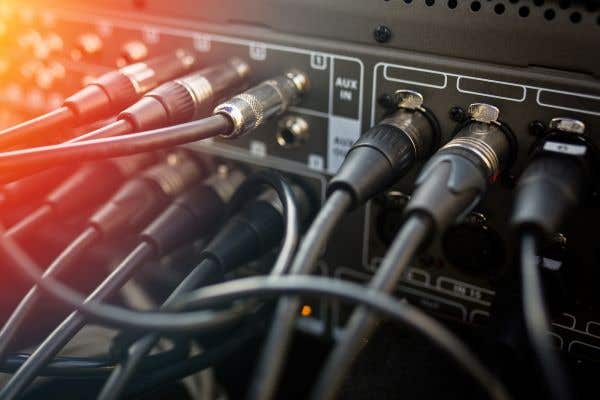
- 5-10ft cables work best for connecting localized gear positioned very closely together. This is also the proper length for 1/4" TS instrument cables for guitar, bass, and keyboards. Anything longer will cause more noise from signal interference.
- 20-30ft cables are a standard length for mics, direct boxes, instruments with direct outputs, and stage monitor speaker outputs that connect to your snake or partnered stagebox across the stage. I have found that you should have the most extra cables of this length.
- 50-100ft cables are used for connecting your main PA speakers and subwoofers to your mixing console to accommodate the fact that they may need to stretch longer distances to reach all sides of the stage.
Having the right number of cables at the proper lengths also gives you the flexibility to position everything cleanly and in an organized manner. Stage clutter is one of those problems that can sneak up on you. Tangled, wadded, crisscrossed messes of cables can limit freedom of movement on stage and make any later adjustments a living nightmare. Not to mention the risk that a mic stand topples over or a piece of expensive gear gets yanked because something needed to be moved around and its attached cable was tangled or pulled completely tight…
Let’s just say, there’s a lot that can go wrong. Stay organized out there with plenty of cables.
4. Adapters, Connecters, and Interconnect Cables
I know, I know… This technically isn’t one thing. But humor me and think of them as one big bundle.
It’s bound to happen… A performer will forget a certain cable, someone will pull out a piece of gear that has a different input or output jack than you anticipated, or you’re being told that you need to extend the distance of a speaker away from your console or stage box — a distance much longer than the longest cables in your collection. Now you’re panicking and pulling up directions to a music store at the last minute instead of being able to focus on your setup in the moment.
Here is my recommended collection of price-friendly couplers, adapters, and cables that will expand what you can cover and help you handle those unexpected changes:
- Couplers for XLR and 1/4 “ TRS cables
- XLR Female to 1/4 “ TRS Adapters
- XLR Male to 1/4 “ TRS Adapters
- 3.5mm TRS (Stereo Headphone) to 1/4" Left and Right Interconnect Cable
- 3.5mm TRS (Stereo Headphone) to RCA Left and Right Interconnect Cable
- RCA Left and Right to 1/4” Left and Right Interconnect Cable
These will cover you and keep your setup moving smoothly in the event of those sudden last-minute requests.
That being said, it’s always preferred long-term to use a single cable rather than coupling multiple cables together or chaining a bunch of adapters. That’s because introducing an extra point of potential failure in any circuit increases the likelihood of noise and signal dropoff. This becomes more evident with heavy use and abuse on stage over time — connectors will wiggle, loosen, and lose connection at the point of contact. And while it isn’t likely for performers and audience members to step directly on top of these, it’s only a matter of time before someone does.
If you find yourself using the adaptors constantly, you should take the time to pick up some additional single cables of the proper length with the necessary connectors. That way you can limit wear-and-tear on your own adaptors and keep them working well for much longer.
4.5. Adapters, part 2: Phones and devices
Incorporating phones, tablets, and laptops into a set playing backing tracks, triggering samples, and managing music at intermission has become commonplace. The more recent generations of many of these devices have phased out the 3.5mm headphone output, choosing to focus connectivity through USB and wireless over Bluetooth.
Please excuse me as I shed some tears in protest… But alas, the show must go on. So we need to adapt.
Make sure to stock your rig with a couple of special connectors specifically for mobile devices. One side plugs into the device’s charging port (male) and the other takes a 3.5mm audio cable connection (female). Someone inevitably is going to come to you and say, “I need to get sound off my phone for the show” and then shrug their shoulders when asked if they have their own adapter. And you’ll be ready.
Most modern Android devices use USB-C, so make sure you have a couple USB-C to 3.5mm adapters handy for a wired connection to a mixer or PA.
Now, when it comes to Apple products, it’s best to use one of their branded special adapters (“dongles”). While the newest iPhones now have a USB-C port, there are still plenty of models out there with a Lightning port. So, be sure to pick up both an official Apple USB-C to 3.5mm *and* a Lightning to 3.5mm adapter (again, two of each is a good thing).
And with the 3.5mm TRS to 1/4" Y-Cable I mentioned above, you’ll be able to easily incorporate the phone into your live mix. Simply connect to a stereo channel on a mixer or to a stereo direct box and easily run a balanced signal over long distances.
Make sure you label all these connectors clearly because they do have a tendency to get “accidentally” picked up and taken by the people using them. I recommend labels with eye-catching neon tape, the brighter and bolder the better!
5. Tape

When you’re planning your stage layout, there will inevitably be a couple points where you will end up needing to run a cable or two across a more highly trafficked area. Having a roll of gaffe tape nearby can secure those cables down so that somebody doesn’t trip. When the tunes get more and more rad, we don’t always watch where we are going, so this makes sure everyone will stay safe.
Picking up a roll of masking tape, blue painter’s tape, and brightly colored duct tape to have in your bag will also cover all your labeling needs, like marking stage plots for spacing, labeling channels on a mixer, and tagging your equipment for easy identification, and so on.
6. Portable Digital Recorder
In my experience, one of the biggest values out there for sound operators is a portable digital recorder. You can use one for all sorts of things: recording rehearsals and pre-show meetings, receiving a copy of the stereo mix from your mixer and pairing it with a DSLR camera or video recording device to create professional and great sounding media clips, recording an extra backup of the show, testing sound levels in various areas of the room, and lots more!
Digital recorders utilize SD-card memory storage and feature both high-quality built-in microphones and inputs for external microphones. Plus, these powerful, compact tools can easily fit in your backpack or studio bag.
American Musical Supply Makes It Easy to Buy the Live Sound Accessories You Need!
Thanks for reading, and we hope these accessories will help your audio engineering duties go much more smoothly. AMS is excited to be your headquarters for all things instruments and gear — with 0% interest payment plans serving as the ultimate no-hassle way to pick up your live sound essentials all at once!
And if you still have questions, contact the AMS Customer Service team at 800-458-4076. They’re all experienced musicians and can happily answer all your gear-related questions.