
One of the most important innovations in the world of guitars has been the use of overdrive. You know it; you love it! It pushes your amp into that crunchy, fuzzy, warm, and sometimes even screaming tone that has ruled blues, rock, metal, and, well, basically every genre since it came about.
So, what is overdrive? And isn't it really just a fancy word for “distortion”? Spoilers: NO!
Let’s take a more in-depth look at the OG gain-booster and why you absolutely (probably) need one on your board.
What is an overdrive pedal?
An overdrive pedal simulates the cranking of a tube amp, giving you that smooth sound that you get from “cranking” a tube amp perhaps just a little too much. The tone of the guitar is perceived as pleasing and smooth, providing a nice shaping tool to create music with.
So… how does this happen? When a guitar signal experiences what’s called “clipping” (when the signal is too strong for the device to handle), the peaks of the waveform are rounded and compressed, providing a smoother, harmonic texture for your sound. This responsiveness can encourage a more nuanced approach to playing, where any subtle changes in technique can result in noticeable tonal variations.
Players like Eric Clapton, Joe Bonamassa, Billy Gibbons, and Robben Ford are known for their signature guitar tones and don’t shy away from experimenting and venturing out to the lands of overdrive and distortion. To give you more of an idea on how deep you can go with overdrive, below are a few categories into which we can narrow our search:
Types of overdrive tones
Tube Screamer Style
This style of overdrive is mid-heavy and was developed in the 1970’s. Stevie Ray Vaughan fans, you know what it’s all about! Honestly, you can use this in pretty much any environment where you need a little extra boost or drive to your sound. Tube Screamers are also great for tightening up high-gain amps when you keep the drive low. Examples:
Marshall Plexi/Blues Breaker Style
The Blues Breaker circuit was created in the 90’s to emulate a Marshall amplifier with the same name. The Bluesbreaker is much more a transparent overdrive that became popular once John Mayer started using it on his ‘Continuum’ album. Examples:

Klon Centaur
Considered the holy grail for overdrive tones for guitarists. The Klon Centaur was intended to replicate the overdrive of a cranked amp, without any pedals. This is a type of overdrive called transparent overdrive, where you don’t lose the character of your original tone, hence why they labelled it “transparent” overdrive. It’s great for stacking on top of your overdriven sound too, acting like a solid boost. Because of its high value and rarity in the marketplace, you probably won’t find a real Klon laying around in a Goodwill any time soon. However, you can replicate it pretty close with other pedals. Examples:
Dumble-style
What guitarists search through the deserts and valleys to come close is the Dumble sound. It gives a warm breakup response, compressed, tube-like overdrive sound. If you’re a Robben Ford, Larry Carlton or Joe Bonamassa fan, this is it. Since Dumble amps are hard to come by and will set you back around $100K+ (if it's on sale), you can find pedals that replicate this legendary sound without breaking the bank. Examples:

Hard clipping/Overdrive
Want to push your overdrive even further? If you’re playing heavier styles and want more saturation in your tone, you’ll want to move towards the distortion/overdrive realm. Examples:
Overdrive from the beginning
Let’s travel back in time real quick. In the beginning, overdrive wasn’t accessible as a pedal you could just put on your board. It was something that guitarists in the early 50s achieved by driving their tube amp’s volume to the point of overload and breakup. By doing this, their sound became more saturated, adding some gas to their tone without completely altering the guitar sound.
Guitarists like Chuck Berry and Freddie King can be heard with a slightly overdriven guitar tone that comes from a cranked amplifier. From there, countless rock and roll and blues guitarists heavily utilized this effect, creating the iconic driven tones we know and love.
As the 60s came, players were experimenting with even higher gain to get more aggressive tones. The introduction of the Maestro FZ-1 Fuzz Tone came into being in 1962. Keith Richards of the Rolling Stones used it on the song “(I Can’t Get No) Satisfaction”, which you can hear is immediately present in that opening riff. Then fuzz and overdrive had become increasingly popular and began to take shape by the late 60s and early 70s. Bands like Led Zeppelin and The Who were among the many that started utilizing overdrive and fuzz in their sound.
Of course, fuzz pedals are intense, and players wanted a smoother overdrive tone without the sometimes-harshness of a fuzz. This sets the stage for the first ever true overdrive pedal that would be introduced in 1977, the Boss OD-1. This would set the industry standard for compact pedals, as this was considered one of the first made.
Companies like Ibanez hopped on the pedal train and came to develop the Tube Screamer in 1979, which aimed to emulate the sound of a hot tube amp but brought down to lower volumes so you can enjoy it even in smaller playing settings. Stevie Ray Vaughan used this to add more “beef” to his sound without coloring the tone too drastically. Even B.B. King used a tube screamer for some extra mileage in his notes. The Ibanez Tube Screamer is still a staple for guitarists all over.
Where to put overdrive in your signal chain
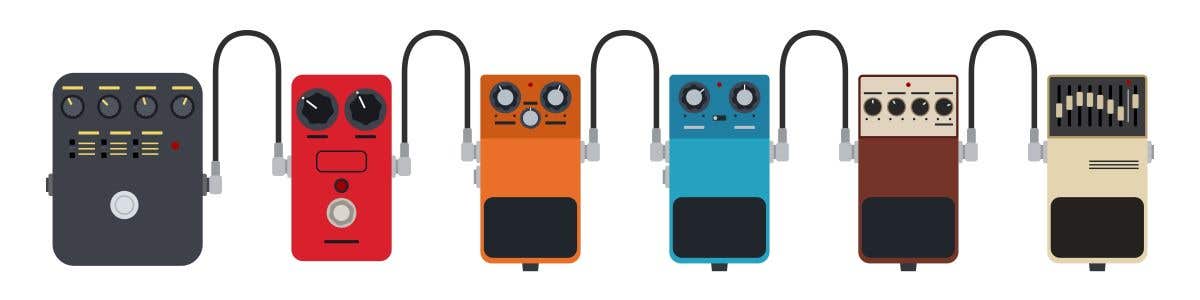
There’s always been some debate about organizing pedals in your signal chain. A typical signal flow should have your wah pedal and envelope filters first, then your overdrive and distortion pedals, followed by your modulation (chorus, flange, phaser, etc.) and then any time-based effects (delay, reverb, etc.). You definitely don’t want any overdrive limiting your reverb… would ya?
I would recommend putting your overdrive pedals and distortion pedals so the lightest gain is first in the chain and then the heaviest can go last. But does it really matter? Let’s put it this way: You’re don't want to compress the gain coming from a high-output pedal down to one with lower gain.
If you want to dive more in depth into signal flow, check out our article Pedal flow 101: How to organize your pedalboard for all the juicy deets.
Is overdrive the same as distortion?
A question that comes up often is “isn’t overdrive the same as distortion?” And at first you might think so, but what makes them distinct from each other is the type of clipping that happens.
Overdrive utilizes “soft clipping” which pushes your signal to the point of overdrive, giving you a smoother, more driven tone without changing the overall nature. Many players don’t want to completely alter their tone and wish to retain the sound of both the guitar and amplifier.
Distortion uses “hard clipping” which provides a heavier, more saturated tone than an overdrive pedal. Distortion gives the user the ability to play legato or “violin-like”, which makes a series of notes seem like one continuous line. Makes sense for all you Yngwie Malmsteen shred-heads out there! The beauty of overdrive is that it still gives room for the notes to breathe, while distortion blends the signal into one, allowing technique to take the passenger seat for a little.
Overdrive is designed to work better with tube amps, while distortion is more of a “take-no-prisoners" type of pedal that works with nearly any amp — tube or solid state.
What’s popular in the overdrive pedal world?
Selecting the right overdrive pedal depends on the desired sound, playing style, and the rest of the gear. Consider the pedal's clipping style, tonal characteristics, and how it interacts with your guitar and amp. The pedal's responsiveness to playing dynamics and its ability to retain the guitar's natural voice are also key factors in determining the type of pedal that’s right for you.
Below is a list of some of the most popular overdrive pedals that would look (and sound) good on any board:
- Ibanez TS808 Tube Screamer
- Boss SD-1 Super Overdrive
- Origin Deluxe55 Tweed Recreation Overdrive Pedal
- Boss BD-2 Blues Driver
- Soldano SLO Overdrive
- Warm Audio Centavo Overdrive
- PRS Horsemeat Overdrive
Of course, there’s so many that the list could go on for pages. One thing to note is that you should look into a handful of overdrive pedals before deciding — unless you’re already set on what tone you want to emulate. It’s also a good idea to browse some videos and listen to the sounds of each pedal before making your final decision.
Time to (over)drive it all home!
If you’re overwhelmed looking for an overdrive pedal and still unsure about what kind of sound you’re going for, the AMS Customer Service experts are always more than happy to give some advice. Give us a call at 800-458-4076 to talk to a gear nerd today. There are tons of pedals out there, and we can help you find the perfect one to suit your unique tonal needs.