Going wireless as a guitarist is one of those decisions that changes how you play. The obvious benefit is freedom of movement — no more tripping over cables or dragging a lead across the stage when you move. But just as important is reliability and tone. A good wireless system should make you forget you’re even using one. The wrong choice, on the other hand, can mean dropouts and interference.
Today’s systems are light years ahead of the old ones. Modern digital wireless delivers cable-like tone, ultra-low latency, and dependable performance at every budget level. Let’s walk through what makes a good wireless guitar system and break down the best options available at American Musical Supply — from top-tier gigging rigs to budget-friendly practice solutions.
What Makes a Good Wireless Guitar System?
When you’re shopping for wireless, keep these key factors in mind:
- Frequency Band – High-end systems often run in Ultra-High Frequency (UHF) or dual-band digital ranges. The wider the frequency band, the more options you’ll have, and the less interference you’ll have to worry about from pesky things like radios, Wi-Fi, and your bandmate’s wireless system.
- Latency – The time between when you strum and when you hear the sound. Anything under 5 ms is imperceptible; the best systems are 3 ms or lower.
- Battery Life – Aim for at least 6–8 hours.
- Range – For stage use, you want 100+ feet.
- Durability – Metal housings and secure jacks matter for gigging.
- Dynamic Range and Audio Quality – Look for 20 Hz–20 kHz response with 110 dB+ dynamic range.
High-End Systems: Stage-Proven Reliability
Shure SLX-D14 SLX-D
A dual-channel UHF digital system with rock-solid RF performance and up to 32 channels per band. The Shure SLX-D delivers 24-bit audio, 120 dB of dynamic range, and about 8 hours of runtime. Perfect for players who need uncompromising stability.
Want to go rechargeable? That’s where Shure’s SB903 lithium-ion battery comes in. Swap it in, and you still get about 8 hours. And the transmitter/receiver will display battery life in hours and minutes.
Shure GLXD14R Plus
The GLX-D+ is Shure’s rack/dual-band (2.4 + 5.8 GHz) option in the GLX-D family. The big upgrade: it includes the SB904 rechargeable lithium-ion battery, giving you up to 12 hours of continuous use on a charge. You can charge it in the receiver’s front panel bay or via USB. Also, a quick 15-minute top-up gets you another ~1.5 hours of play.

Sennheiser Evolution Digital CI1

The EW-D CI1 delivers clean UHF digital audio with an amazing 134 dB of dynamic range, meaning it handles everything from soft picking to aggressive strumming without compressing your tone.
It ships with standard AA batteries (about 8 hours of runtime) but supports Sennheiser’s optional rechargeable setup:
- BA 70 Lithium-Ion Pack — Up to 12 hours of use
- L 70 USB Charger — Charges one or two BA 70 packs at once
Setup is quick thanks to the Smart Assist app, which handles syncing, frequency scanning, and battery monitoring from your phone. Reliable, quiet, and easy to run — it’s ideal for players who want pro-level clarity without overthinking their wireless
Mid-Tier Systems: Dependable for Gigging
Line 6 Relay G10SII

The Line 6 Relay G10SII is one of the most user-friendly, plug-and-play systems out there. Instead of a bodypack, you get a small transmitter that docks into the receiver for charging and syncing — no cables, no confusion. It delivers clean, transparent audio, and Line 6 even provides a “cable tone” switch if you prefer that slight high-end roll-off of a traditional cord.
It has a solid, 130-foot range, so it’s the kind of system you can toss on a pedalboard and forget about until someone else’s wireless drops out and yours doesn’t.
Boss WL-50
The Boss WL-50 is designed with one primary goal: simplicity. Built into a standard Boss stompbox housing, it fits seamlessly onto a pedalboard. Dock the transmitter, it auto-pairs, and you’re good to go — no menus or frequency scans.
Latency is 2.3 ms, and the built-in cable tone simulation keeps things sounding familiar if you’re used to analog leads. It’s not flashy, but it’s rock-solid and predictable — exactly what you want when you’re already worrying about singing, switching patches, and not stepping off the front of the stage.
NUX B-8

The NUX B-8 gives you a feature-rich wireless system at a fair price. It’s a pedal-format receiver with a built-in tuner, boost, and even a DI out if you want to run straight into the mixer. It has very low latency (around 2.5 ms) and boasts roughly 6.5 hours of battery life on a single charge. This is an ideal wireless system for house-of-worship setups, weekend cover bands, and anyone looking for a solid wireless system at a reasonable price.
Affordable Systems: Home, Rehearsal, and Small Jams
Xvive A58 Digital 5 GHz


The Xvive A58 is the grab-and-go wireless setup for players who just want to plug in and walk around.
Running on 5.8 GHz instead of the crowded 2.4, it avoids a lot of interference before it even starts. Latency is around 5 ms — not studio-perfect, but totally fine for practice, rehearsals, and smaller gigs. Battery life is about 5 hours, so it’s not your all-day warrior. But if you want wireless at home for a very reasonable price, the A58 is a solid choice.
NUX C-5RC 5.8 GHz
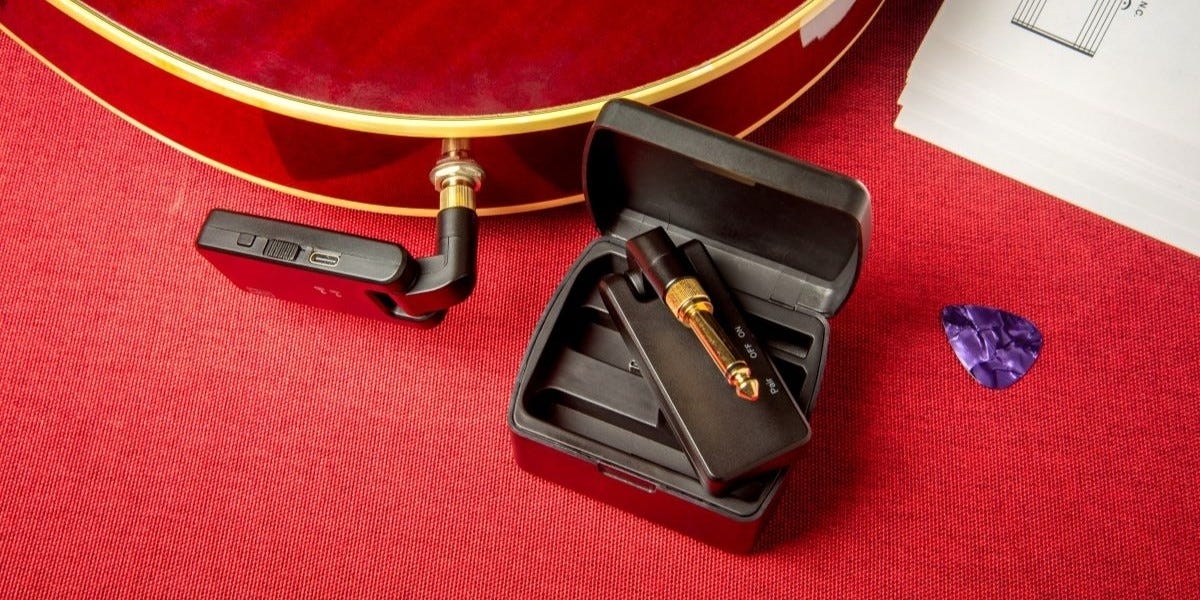
The NUX C-5RC is like the A58, but with a few distinct advantages. It has the same basic plug-in transmitter/receiver setup, but it comes with a charging case — like AirPods for guitarists.
Each unit runs about 6 hours, and the case can top them up for about 15 hours of total use, which makes it more viable for back-to-back rehearsals or long sets. It’s simple, compact and the charging case is there to back you up if you need to top up between sets.

Fender Telepath Wireless

The Telepath is Fender doing wireless the Fender way — straightforward and reliable. It runs for about 8 hours on a single charge (a full charge takes 2 hours), and it has a range of ~70 feet. It charges via USB and syncing is a synch. Latency is 4 ms, so it maintains a natural playing feel. It’s great for home jams, rehearsals, and small venue gigs.
Ready to Live the Wireless Life?
Wireless gear is one of those purchases where you really do get what you pay for. A cheaper system might work perfectly fine in your practice space — but as soon as you throw it into a live environment with stage lights, Wi-Fi interference, and a room full of cell phones, that’s when weak links tend to reveal themselves.
That’s why higher-end wireless isn’t just about better tone — it’s about predictability. You’re paying for signal stability, longer runtime, smarter frequency management, and hardware that’s roadworthy
But let’s be fair — not everyone needs stadium-level wireless.
- If you mostly play at home or rehearse, budget systems are fine.
- If you’re gigging regularly, the mid-tier options are the sweet spot.
- If you’re playing events where failure is not an option, step up to the premium level and sleep well.
So don’t buy more than you need… But don’t buy so little that you end up thinking about your wireless more than your playing.
Pick your tier, trust your rig, and enjoy not being tethered to anything except the groove.