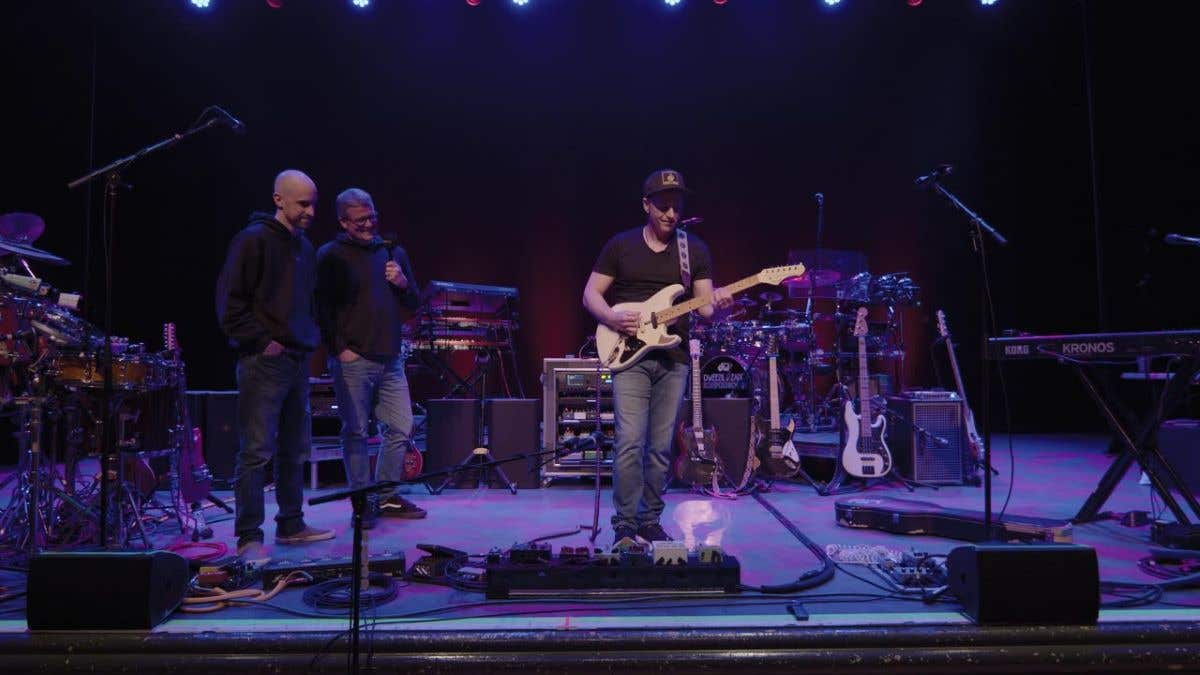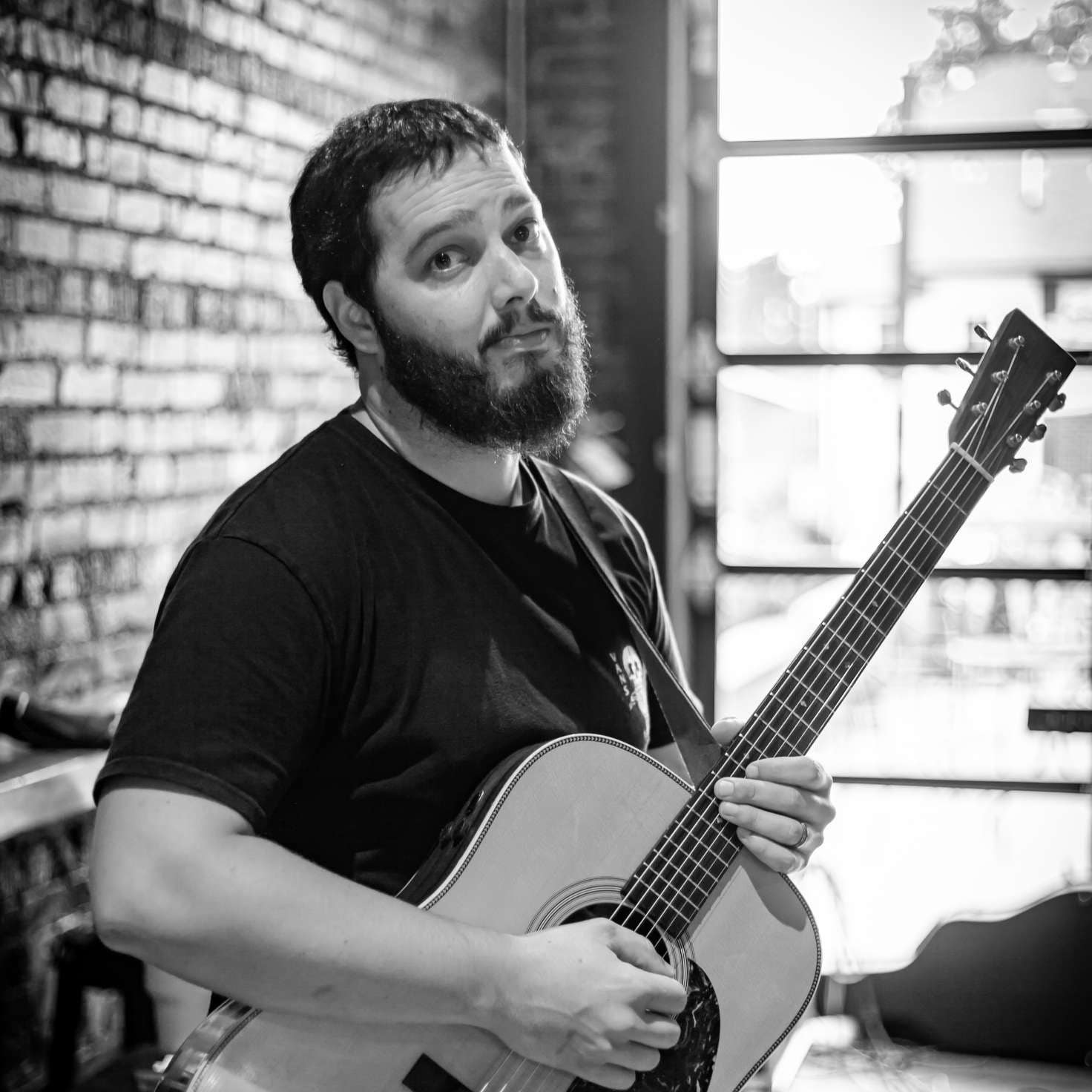
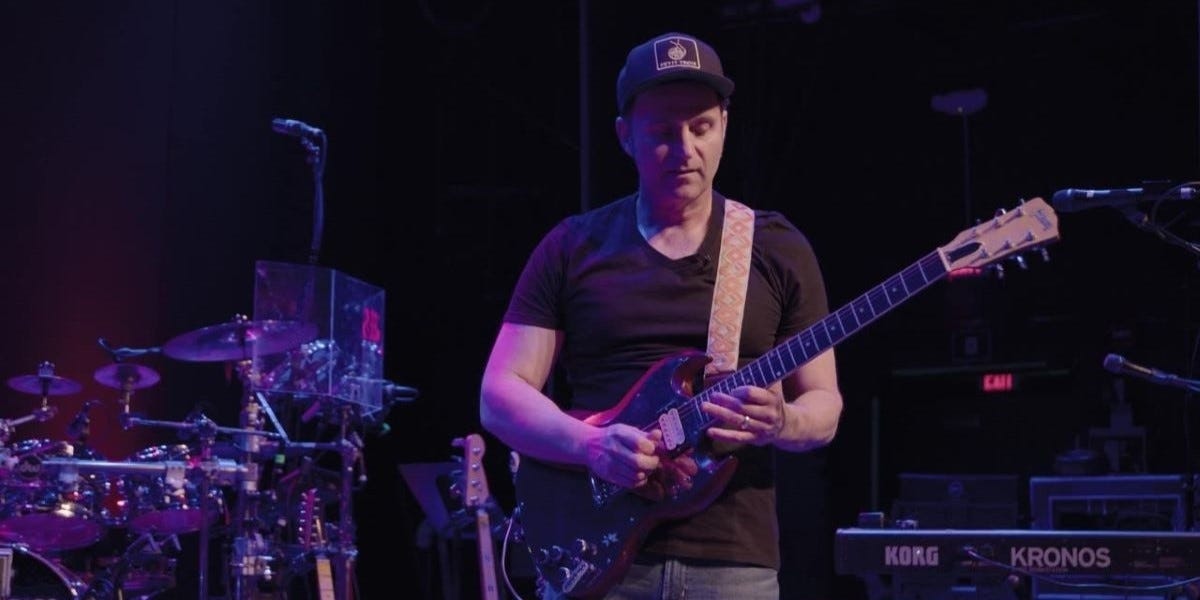
Where is the Ridgefield Playhouse? Well, it’s in Ridgefield, Connecticut of course! And that’s where we ran into guitarist-extraordinaire Dweezil Zappa. He and our buddies at Universal Audio were kind enough to invite AMS’s Russ and Ryan on stage, give them a few lessons in shred, talk about his processes for learning super-hard Frank Zappa and Eddie Van Halen songs, and all about his gear. Check out the AMS Dweezil Zappa interview right here.
“Feel is everything at the point of creation”
Heavy rock means heavy picks and strings, right? Well, according to Dweezil Zappa, that’s not the case at all. In fact, he prefers playing with light strings and picks. Why? Because it’s all about that feel!
Within the first few minutes of talking to Russ and Ryan, Dweezil went into a full-on masterclass about strings and picks. He showed that using a heavy pick to do EVH-style pick slides just doesn’t have the same sound. The lighter picks resonate against the strings better, creating the iconic sound.
Light picks also add more “snap” to the playing, helping with pinch harmonics and smooth playing.
And although Dweezil does dabble in heavy music, he prefers using light-gauge strings. He goes all the way down to 0.08s! He even told us that his dad, Frank Zappa, used 0.07s back in the day. They were so light that you couldn’t find them in regular guitar string packs. He had to steal them from banjo sets!
If you’re still into the “heavy strings and picks make heavy music” mentality, just check out the first portion of the interview. The debate is officially over!
Of course, that’s not to say you HAVE to use light strings and picks. As Zappa said, “Feel is everything at the point of creation.” Everything between your fingers and the amp, even something as seemingly insignificant as the pick thickness, goes into creating your sound and feel. Use what feels right for you, and the sound will come.
The Gear for Zappa's Rox(postroph)y Tour
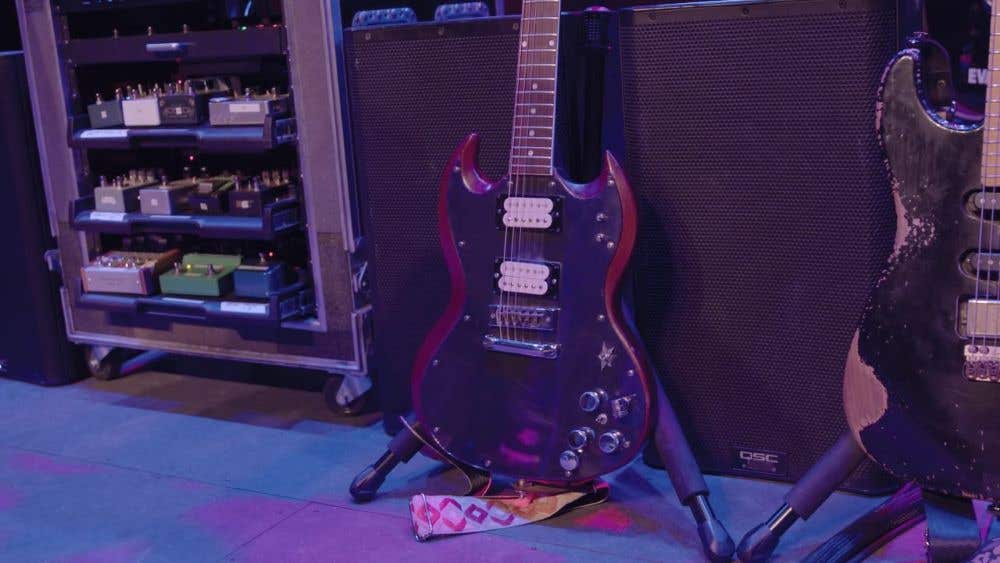
Well, the big gear news is pretty evident just in the title of the tour. That’s right; Dweezil brought Frank Zappa’s famous Gibson SG “Roxy” on the road to celebrate 50 years of both Roxy and Apostrophe.
Joining Roxy on stage was a modded-out Gibson Les Paul, known lovingly as the “Shut Up n’ Play Yer Guitar” Les Paul after the Frank Zappa tune (it was the one used on the record), and two Shabat Lynx DZs with super-smooth Vega tremolos.
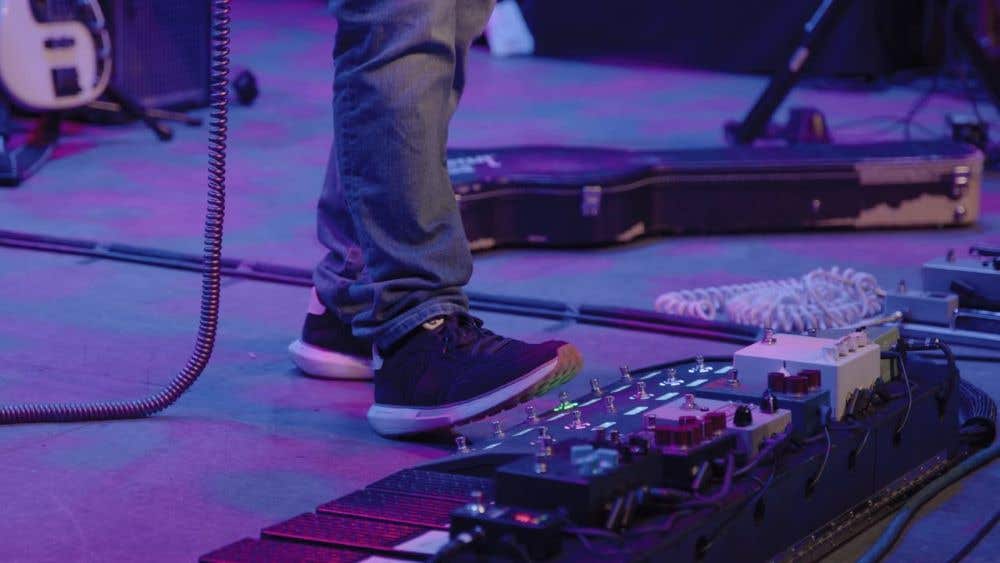
Zappa runs his guitars into a (deep breaths, everyone) digital amp modeler that he runs in stereo with several other effects. Dweezil told us that he has over 120 presets that he swaps between throughout every show. He’s gotten quite good at timing the tap dance — especially on songs like “Push Comes to Shove,” during which he has to play a solo live that he knows for a fact was not a one-take solo in the studio…
The trick to coming up with such full, thick tones is to always have a clean signal underneath the wet, just like his dad used to do. You’d be surprised with the difference it makes!
What does Dweezil Zappa use to get sound out of his modeler? A pair of simple QSC K12 speakers. They really pack a punch and don’t add unnecessary color to the tone coming from his modeler.
That’s all it takes to rock as hard as Dweezil Zappa — well that and, you know, tons of skill…


Don’t Get Attached to Gear
Growing up in such a musical household, Dweezil had access to tons of the most high-tech gear of the 20th century at an early age. So you might think he’d have a real connection to the gear, but that’s not entirely the case.
According to Zappa, it doesn’t make sense to create a mental attachment to a specific thing. “It’s not a feasible way to live.”
And to prove his point, he told a story about going on tour in South America when the techs were moving the drum kit and knocked over his guitar, breaking the headstock. Everyone went into panic, thinking he’d yell and scream and cancel the show. But he had a backup guitar, so it was no big deal. The show happened just like normal.
If you get stuck having to have that one specific piece of gear, you open yourself up to all sorts of potential problems. If that had happened to some other guitar players, it might not have gone down so smoothly.
Dweezil has never really been much of a collector. It’s more about finding the gear you need to make the idea come to life. Look at some of his role models like his dad, Frank Zappa, or Eddie Van Halen. They weren’t afraid to completely rip pickups out of guitars or router new holes to achieve the tone they had in their heads.
When it comes to making music, the ultimate goal is to create any time and do what you want to do. And if that means swapping gear or heavily modifying a 1961 Gibson SG, that’s what needs to happen! According to Zappa, more people aren’t “given the permission or they don’t give themselves permission to pursue that.”
With all that said, though, please be careful with Roxy…
Zappa on Whether Digital Modelers Sound as Good as Real Amps
Dweezil Zappa was an early adopter of amp modelers. He’s been using them for over 15 years. And while they might have had a tough start getting going, modelers are now as good and powerful as ever — even better than real amps…?
The way Zappa looks at it, there are two ways to think about building a rig:
- Sound
- Flexibility
When you’re on the road as much as Dweezil Zappa, carrying all that gear from stage to stage, flexibility is a HUGE part of any rig. It has to be portable, easy to set up, and (perhaps most importantly) reliable.
There’s no competition when it comes to flexibility between modelers and amps. Modelers win 125 times out of 100. They’re small, portable, and easy to set up. Plus, with the number of tones and rigs Zappa needs to go through on any given night, you just can’t beat the tonal versatility of a modeler. He goes through over 120 presets every show! Do THAT with an analog amp.
Now, when it comes to sound, Dweezil acknowledges that real amps are easier to make sound better. However, that doesn’t mean they always sound better. According to Zappa, he has become satisfied with what became possible with modelers sound-wise. But you have to know how to use them correctly!
Using a modeler is like learning a new instrument. You have to know all the settings and craft your tone from the ground up. If you take the time to really learn the equipment, digital modelers are just as good as real amps. Zappa says, “[Modelers] CAN sound better; you just have to know what you’re doing.”
So, when it comes to flexibility, modelers are a no-brainer. And once you know how to use them, like Zappa does, they sound just as good as real amps. They’re 2/2 for Dweezil Zappa, and whenever you hear him play, that’s the power of modern modelers!
What’s the secret to a great modeled sound? According to Dweezil, it’s all about the speaker IR. With the right EQ setting on the IR, all your amps will sound better. If you’re getting into amp modelers, don’t overlook the power of the speaker IRs. It could completely transform your tone!
What’s It Like Playing Some of the Hardest Songs Ever Written?
Playing such legendary (and ridiculously difficult) songs from Frank Zappa and Eddie Van Halen will put a toll on anyone. What’s it like for Dweezil to take on tunes from his dad and EVH?
It’s all about the headspace. You have to be completely prepared before you take the stage or even start the first rehearsal. Frank Zappa wasn’t the usual rockstar who shreds guitar and solos with complete disregard; he was a composer, and the band was his orchestra. Every single part is meant to be there, and it has to be there for the emotionality to make its way through.
To ensure each part comes through, Dweezil puts two and sometimes three instruments on the same part, even the fast stuff. If one person drops out, two others will (hopefully) be there to take their place. Of course, sometimes two players drop out, leaving one person to play these ridiculous masterpieces alone. When that happens, Dweezil says it’s kind of like the scene in Star Wars with Luke left alone to blow up the Death Star. “Stay on target…” *sweats profusely*
Frank Zappa was also known for creating multiple versions of his songs, and Dweezil has played tons of them over the past 1,500+ shows. According to him, it’s fun to play the rarer versions of the songs. It makes it more special to keep them alive.
This current tour, Rox(postroph)y, is a little different than the other tours Zappa has done. Instead of playing the songs as note-for-note as he could, he’s having a bit more fun with the music. This is the first time he’s adding more personality to everything. He’s being goofy, improvising with the band, and becoming a “Chameleon of the Moment” as the bandmembers add new parts and vibe off one another.
Apparently he even becomes a temperamental Penguin King at one point in the show…?
At the end of the day, Dweezil’s motto is, “I’m going to play this stuff the best I can and let the music speak for itself. If you think you can do it better, good luck!”
Coming Soon from Dweezil Zappa (hopefully…)
Dweezil has been pretty busy lately with the Rox(postroph)y tour, but he also has a special project in the works called “What the Hell Was I Thinking?” The initial idea was to make a continuous piece of music called “22” that was 22 minutes long with a ton of different musicians that constantly changes tempo, volume, style, like the listener is always turning a knob on a radio.
Apparently that wasn’t good enough, because it eventually transformed into a 75-minute-long composition — the entire length that fits on a CD. Naturally, about this point, it was retitled “What the Hell Was I Thinking?”
This album(?) has been in the works since the ‘90s, and Dweezil already has several tracks with legendary guitarists like Steve Vai, Eddie Van Halen, Brian May, Malcom and Angus Young, Steve Moorse, Yngwie Malmsteen, Joe Walsh, Albert Lee — only to name a few. He’s been slowly releasing some of the music on his YouTube channel (which you should definitely check out), but hopefully one day he’ll release the full composition. Please…?
In the meantime, we had a blast getting a guitar masterclass and listening to the incredible Rox(postroph)y show. A huge thanks to Dweezil Zappa for letting us on stage and hanging out for an hour and Universal Audio for setting it all up. We can’t wait to hear what comes next! Don't forget to check out all the latest gear from Universal Audio right here at American Musical Supply.
If you enjoyed this interview, make sure to subscribe to the AMS YouTube channel for plenty more content just like this!