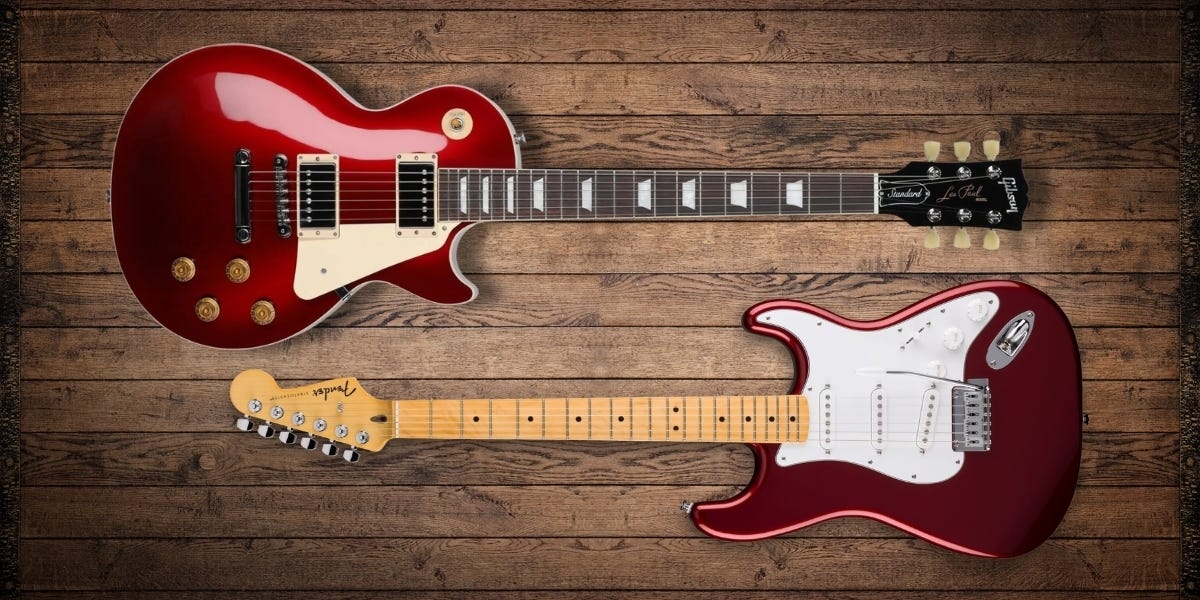
Gibson and Fender are two of the most iconic and impactful guitar manufacturers in the rock-and-roll world. They’ve released countless models that have rocked stages all over the globe. And arguably, there are no more popular guitar models than the Gibson Les Paul and Fender Stratocaster.
Taking the Gibson vs. Fender debate one step farther, let’s take a look at the differences between the Les Paul vs. Strat to see what they each bring to the table and, just maybe, find the one that’s right for your playing style — although there aren’t any rules about having one of each…
Overall Build Specifications
First, Let’s pin down the essential ingredients that make up each model and what sets them apart from one another. We’ll start with the oldest first: Born in Kalamazoo, Michigan USA in 1952, let’s welcome...
Gibson Les Paul
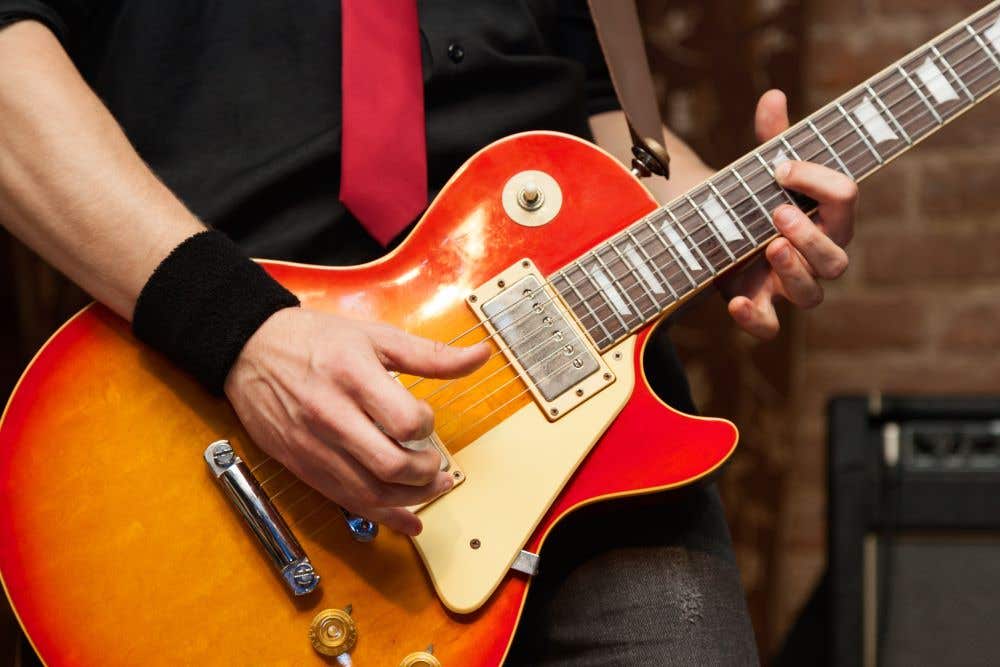
There have been many iterations of Gibson Les Paul including the Custom, Junior, and Special. This will focus on the spec of the Standard model.
- Body: Mahogany with carved Maple top. 2” overall depth
- Neck: Mahogany glued into body
- Fretboard: Ebony or Rosewood
- Tuners: Three on a side tuning machine layout on an angled headstock
- Bridge: “Tune-o-Matic” posted bridge with posted tailpiece
- Electronics: Two humbucking pickups, 3-way Pickup selector, 2 Volume, 2 Tone pots
- String Scale: 24.75”
- Frets: 22
- Fretboard Radius: 12”
- Nut Width: 1 11/16”
- String Width at Bridge: 2.9”
- Weight Range: 8-12 lbs.
And in the opposite corner, a model from sunny SoCal, born in Fullerton California USA in 1954. let’s welcome…
Fender Stratocaster

There have also been a multitude of configurations of the Fender Stratocaster, but here are the basic ingredients:
- Body: Alder, Ash or Basswood. Slab cut with “comfort contours” 1.75” overall depth
- Neck: Maple bolted into body
- Fretboard: Rosewood or Maple
- Tuners: 6 on a side tuning machine layout on flat headstock, string tree on E and B strings (sometimes G-D)
- Bridge: “Synchronized” tremolo bridge with 6 adjustable saddles
- Electronics: Three single coil pickups, 5-way pickup selector switch, 1 Vol, 2 tone pots
- String Scale Length: 25.5”
- Frets: 21-22 (depending on year)
- Fretboard Radius: 7.25”-9.5” (depending on year)
- Nut Width: 1 11/16”
- String Width at Bridge: 2 1/16”
- Weight Range: 6-9 lbs
Pros and Cons of Stratocaster vs. Les Paul
Now that we’ve gotten to know our celebrity contestants a little better, let’s dive into what they’re good at and maybe not so good at. I’m sure there are many more nuanced peccadillos available, but here’s my best highlight reel:
Les Paul “Pros”
- Set neck and fixed bridge/tailpiece design makes it sustain for days.
- Short string scale makes it easy to fret wide chord voicings and bend notes widely and accurately.
- Nut width vs. string scale makes string spacing feel wider and grows as you approach the bridge. Soloist heaven.
- Humbucking pickups are RF resistant, making the guitar quiet in any physical setting.
- Neck position humbucker = smoothly dial in quiet rage to mellow jazz in one tone knob sweep.
- Bridge position humbucker = massive lows and chunky mids with clear harmonic overtones.
- Super flexible tonal scope — aside from a funk rhythm part, you could probably show up to any genre band and make it work.
- Fixed bridge makes tuning stable and detuning easier “on the fly.”
- Fixed bridge stays in tune of you break a string (or strings!) during a performance.
Les Paul “Cons”
- Notoriously heavy. If you must stand up for an evening of sets, you might get some help from our friends at Gator or Levy’s straps, but folks with back issues may be advised.
- Fragile. Gibsons do not tolerate falling face forward even a little. A broken headstock is repairable, but it ruins the value of the instrument. (top tip: examine under black light if purchasing used)
- Les Pauls can tend to the darker side of tone and might not be the first choice for surf bands or anyone who might prefer a “brighter” tone.
Stratocaster “Pros”
- Fender’s bolt-on neck construction is practically indestructible and can survive a very physical performance.
- Easier to repair.
- Tremolo bridge for tremolo effects and limited “dive bomb” tricks.
- Single coil pickups “sit up” in a mix without needing to be louder.
- Lighter weight makes extended stage time more manageable.
- Typically lower priced.
- Double cutaway is easier to reach higher frets.
- Body contours make playing more comfortable.
Stratocaster “Cons”
- Tremolo bridge and string tree(s) on headstock makes tuning less stable.
- Tremolo bridge makes detuning less accurate (as you tune down the low E to D the other strings will sharp a little).
- Similarly, if you break a string during a performance the other strings will sharpen, requiring a spare guitar.
- Single coil pickups have a lot of bright and chime but lack bass or “punch” needed for some heavier material.
- Bolt on neck and tremolo bridge combine to limit sustain.
- 25.5” scale length makes frets slightly wider spaced, smaller hands may not dig.
Driver’s Seat Observations on Les Paul vs. Strat
The scale length and specifically the overall string length from tailpiece to tuner is what makes the overall “feel” of the guitar. In this respect, the Gibson’s relatively short 24.75” scale coupled with it’s three-on-side tuner layout make the guitar feel “tighter.” The high E and B strings are very short overall and are therefore easier to bend accurately. Same story on the low end, but you don’t bend as much on the low strings.
Conversely, the Strat, with its 6-on-side layout, has almost the exact opposite effect in that the strings get progressively looser feeling as you go from low to high. That, coupled with its longer scale combine to make the Fender feel looser and kind of “stretched out”. It also affects the way the tremolo works by sort of “smoothing” the tremolo effect progressively among all the strings.

I have heard it said that the efficiency of a solid body guitar is how much of the energy in the headstock and neck can be transferred into the body. The Gibson, with its short scale and short string run combined with its glued neck joint and generally chunkier neck could arguably best the Fender in this department, causing it to have a lot more bass and presence.
Another player’s observation has more to do with the hard-tail/soft-tail issue. I like to play a lot of double stop and triple stop bends. When you bend a note on a Strat, all the other strings lose a little pitch, so the note you’re holding down is dropping in pitch as you bend another string. It’s a small thing but it does sound a little “crisper” when played on a Gibson.
Weight is an issue of course, but owning a mid-‘70s Norlin era Les Paul, I can tell you one thing: when you hit this guitar it does not move even a little bit. If I pick up my Strat after playing my Lester for a while it almost feels like it’s trying to get away from me; it’s so slippery and light!
Popular Les Paul and Stratocaster Players
Okay, let’s be honest. We really only pick guitars because we see our favorite players bring them up on stage, right!? So, who are some of the most famous players to ever take the stage with a Les Paul or a Stratocaster? The list is too long to include in one article, but here are some of the highlights:
Famous Gibson Les Paul Players
- Les Paul (duh)
- Jimmy Page
- Slash
- Joe Perry
- Billy Gibbons
- Joe Bonamassa
- Alex Lifeson
- Duane Allman
Famous Fender Stratocaster Players
- Jimi Hendrix
- Eric Clapton
- Stevie Ray Vaughn
- Jeff Beck
- David Gilmour
- Eric Johnson
- John Frusciante
Stratocaster vs. Les Paul: Which Is Better?
Let’s face the music here and admit there’s no way we’re asking you to decide between one or another of these beautiful models (or any other model for that matter). In fact, I think we should agree to make it a double date. Maybe we can get Uncle Tele to drive…
Realistically speaking, as a band leader auditioning players, I would absolutely expect my guitarist to be able to cover the tonal landscape that is possible between these two guitars.
As mentioned above, you probably won’t be pulling out the Strat for the Slipknot cover gig, just as a Les Paul might be a little bit much for a surf gig or even a lot of country material.
Also, as mentioned above, if you play on stage, you need a backup. Why not this duo? They have only fueled the entire rock and roll movement from the very beginning. It might be a good thing for you to put on your “likes” list.
At the end of the day, it’s all about what guitar fits your style best. If you like heavy tones and tons of bending, a Les Paul might be the best fit. However if you want brightness and a super-fun whammy bar, then perhaps a Stratocaster is the one for you. No matter which one you choose, you’re going to come out on top!
Ready to Pick a Side?
Ready to take on the Les Paul vs. Strat debate for yourself? There’s only one way to figure out which is best for you… And that’s to try them!
At AMS, we have tons of Gibson Les Paul and Fender Stratocaster models just itching to join your arsenal. And if you have questions, our team is standing by to help you shape your music. Just give us a call at 800-458-4076. With a Strat or Les Paul in your arsenal, there’s no stopping you!