
A lot of factors go into the tone of an electric guitar: The type of guitar construction (solid body, semi-hollow body or hollow body) will have a major effect. The wood will have an effect. The type of bridge and tremolo system (or lack thereof) can affect the tone. But there’s one thing that has arguably the largest effect on the tone: the pickups. And more specifically where they are placed under the strings.
One of the earliest electric guitar pickups was called a “Monkey on a Stick.” Made by DeArmond in 1939, it was a rod mounted to the tailpiece with a pickup that could slide between the neck position and the bridge position. Gibson had a run at the concept in 1973 with the Grabber G3 bass, which also featured a sliding pickup. Almost all electric guitars in current production have a pickup selector switch and pickups mounted in the neck and bridge position. Let’s take a closer look at the difference between the neck and bridge pickups.
Quick Pickup Primer
First, let’s touch base on how an electric guitar pickup operates. The strings are grounded to the guitar’s electronics, making them slightly magnetic. The pickup consists of a spool holding magnetic pole pieces. The spool is wrapped with a coil of thin, coated copper wire. When the string vibrates over the pole piece, the magnet senses the vibrating electromagnetic field (the grounded string) just out of reach and changes the electrical charge of the coil slightly.
This difference in charge is the signal, and the pickup feeds that signal to the electronic controls and amplifier. Increasing the number of copper windings on the coil increases the output of the pickup. Increasing the size of the magnets increases the output. Moving the magnets closer to the string will increase the output, but the magnets will begin to pull on the string, dampening sustain and causing intonation problems and weird tuning behavior.
It helps to visualize a guitar string when it’s vibrating: If you could see it in slow motion, you would see an arcing vibration in each direction. Since the string is anchored at the bridge, the arc would much smaller, producing less of a magnetic signature above the bridge pickup. Therefore, the bridge pickup must be slightly “overwound” to add strength to the signal. Conversely the neck pickup might be slightly underwound to compensate for its more energetic magnetic signature. This is what really makes the difference between neck vs. bridge pickups on an electric guitar.
Understanding the Bridge Pickup
Brash, Harmonics, Soaring Solo, Feedback (the good kind), More Feedback (the bad kind) Twangy, Surfy, Jangly, Chicken Picken — THIS is the bridge pickup.
Since the bridge pickup of an electric guitar needs more winds in the copper wire, they’re usually considered “hotter.” Aka, they have higher output. If you want to rip a solo, you’ll typically flip to the bridge pickup.
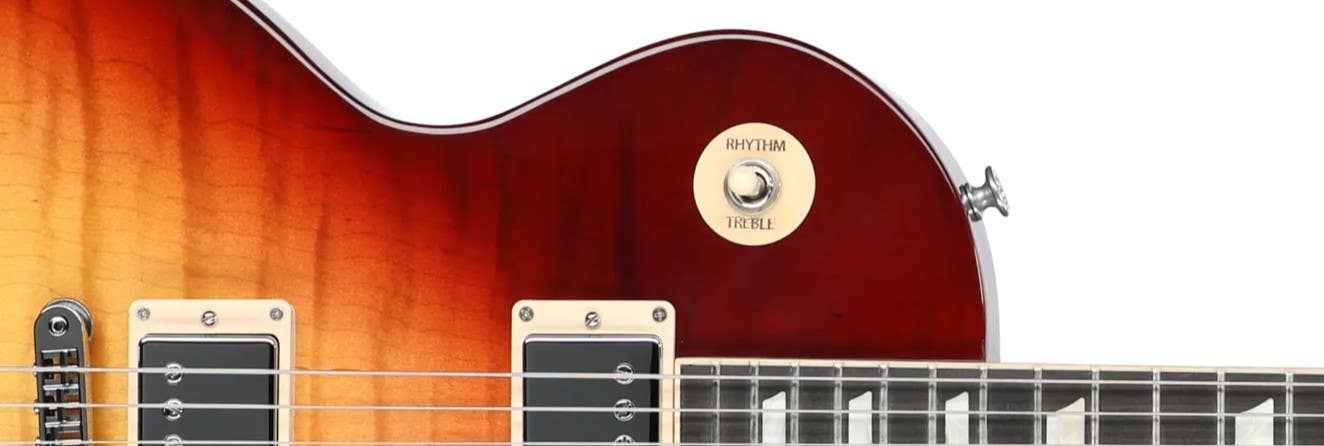
The smaller waves in the string at the bridge position usually give the bridge pickup more treble, sometimes referred to as more cutting. If you look at the pickup selector switch on a Les Paul, it even says “Rhythm” and “Treble.” Want to guess which pickup “Treble” is…? It’ll also have more harmonics and overtones than the neck pickup.
If you ever hear a player using “false harmonics” or “pinch harmonics,” they’re most definitely using the bridge pickup. Since there are lots of harmonic overtones, the chance of feedback is higher — but have some fun with it! A lot of “shredder” guitars completely omit the neck pickup as they feel they really only need the bridge pickup for their preferred tone.
Don’t Forget the Neck Pickup
Warm, Jazzy, Dark, Mellow, Smokey, Meaty, Muted (the good kind) Muffled (not the good kind)
As mentioned, the neck pickup is usually slightly underwound so it can blend in with bridge pickup’s output. The wider arc of vibrating string produces a stronger signal, and the harmonics and overtones are very faint, leaving a pure, warm and dark tone.
The selection between the two pickups is often referred to as lead (bridge) and rhythm (neck). Jazz guitars originally had only one pickup in the neck position. They can be a little muffled when playing complicated chord voicings.
AMS Pro Tip: use the neck pickup when tuning, the lack of overtones makes the tuner read a “cleaner” note. On the same topic, if your guitar has gone a little out of tune during a song, avoid the bridge pickup if possible until you can retune.
Which One to Use: Neck vs. Bridge Pickup
There’s not a hard rule about which pickup you should use. Each guitar will lean into its sweet spot naturally.
A lot of players like to keep the neck pickup turned down a little so you can switch from a subtle warm clean rhythm setting to a saturated lead tone to without tapdancing on your pedalboard.
I like to keep the bridge pickup volume on around 7, so if I hear an overtone or harmonic I want to play with, I still have a little gain to push it over the top (watch Carlos Santana solo).
Find Your Perfect Pickup Match
While you can usually get away with “bridge solo, neck rhythm” mentality, there are TONS of different neck and bridge pickups to choose from. While it’s not super difficult to swap pickups in a guitar… It’s definitely more fun to just buy a new one! Try out all the types of pickups you can to find the perfect combination for your sound.
If you need any help finding your dream guitar or any of the many goodies we offer, call one of the AMS Gear Nerds. We’re here to help you “pickup” the pieces (sorry). Call our toll-free number 800-458-4076.

Ibanez RGDMS8 Multi Scale Electric Guitar Classic Silver Metallic
Special Price $1,299.99
ESP LTD MH1000B Baritone Electric Guitar Black Satin
Special Price $1,199.00
ESP LTD SN1007 Baritone HT Electric Guitar Black Blast
Special Price $1,449.00
Schecter Sunset 7 ET Red Dawn 7-String Electric Guitar Gloss Black
Special Price $1,599.00
Ibanez Iron Label RGRTBB21 Baritone Electric Guitar Black Flat
Special Price $1,299.99
Schecter Keith Merrow KM-7 MKIII Artist L Guitar Lagoon Fade
Special Price $2,199.00
Ibanez Iron Label RGRB720 Electric Guitar Black Flat
Special Price $1,199.99