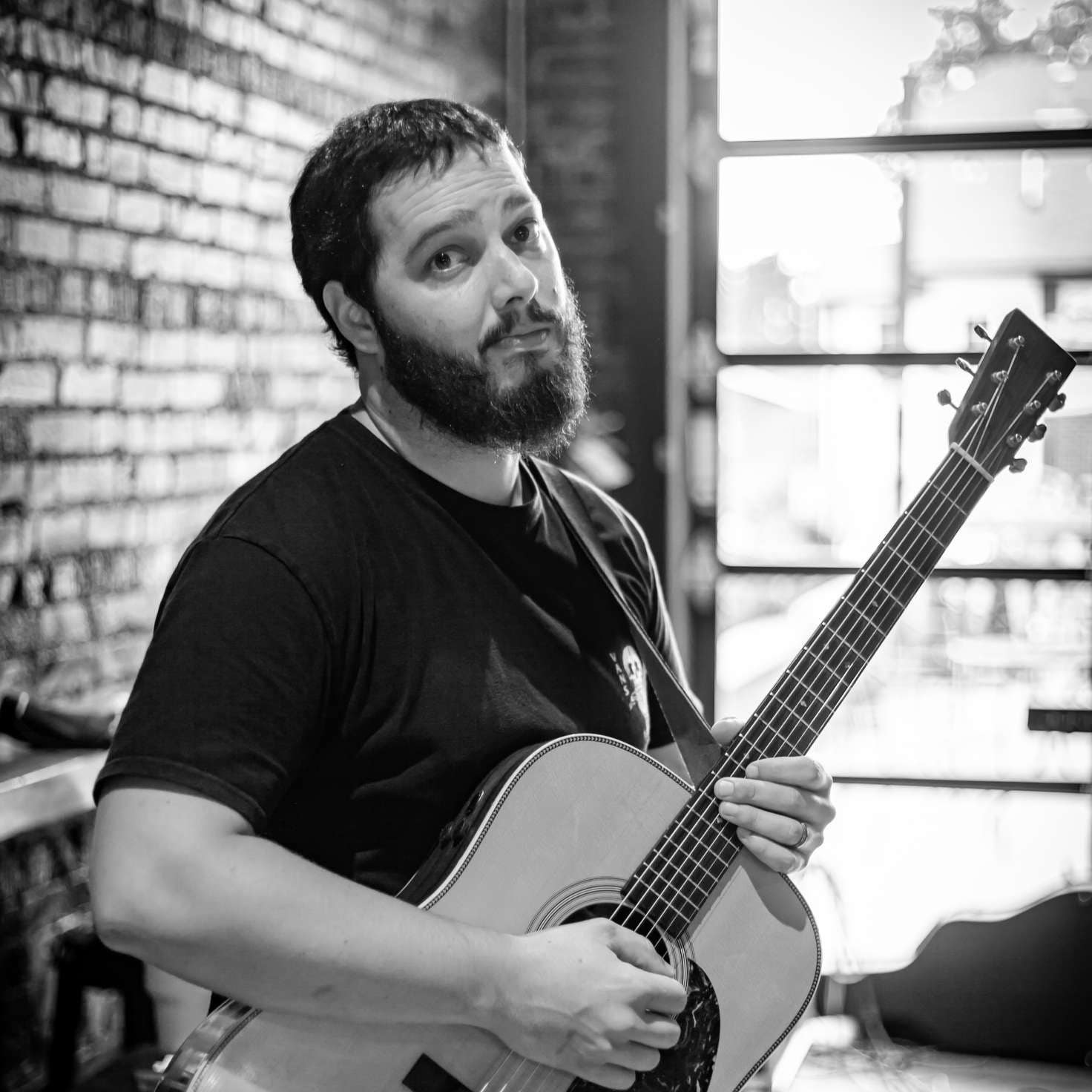

Howdy, howdy! I’m Cameron, and I’m the Managing Editor and Copywriter here at American Musical Supply. My daily activities include editing and uploading blogs (and sometimes even writing a few), writing scripts for AMS YouTube videos, and making sure the product and category pages don’t have any spelling or grammar mistakes — and if you find any, keep them to yourself!
But in addition to rearranging words and correcting peoples’ grammar (whether they want it or not), I’m also a musician. I usually play solo with just me and my acoustic guitar in the corner of some small-town brewery or coffeehouse. Sometimes I’ll pull out my electric guitar to jam at home, if I’m feeling fancy. I like to play mostly covers but arrange them into different styles. It’s always fun to watch people’s faces when my soft acoustic strumming turns into “Hey Ya” by Outkast. And if you’re curious about my favorite gear I’ve used over my past 20 years as a gigging musician, you’ve come to the right place.
Here's “The Gear that Drives AMS,” Cameron edition:
Martin HD-28E
First up is the piece of gear I use (and prize) the most: my Martin HD-28E. I bought my HD-28 back when I first got out of college. My goal was to buy the absolute best guitar possible, so I can stop drooling over other guitars and dreaming about upgrades. And I guess you could kind of say it worked… There are always other guitars to look at…


The best part about the D-28, or really Martins in general — especially their dreadnoughts — is the sound. I actually went to the store planning to buy a Gibson J-45 (I was a big Gibson fanboy at the time). I liked the J-45; it’s a fantastic guitar. But I figured I should probably try something else just to see. So I picked up the HD-28 hanging next to it on the wall, and the Gibson never came back down.
One strum on a good Martin, and your whole chest vibrates with the ridiculous bass response and projection. Nothing else even comes close — at least that I’ve found. One giant credit card payment later, and the guitar was mine!
My HD-28 has been my primary player for almost 15 years now. Even today, it sits on a stand next to my desk, so I can always pick for a few minutes after I finish a blog. If you’re in the market for an acoustic guitar that really rumbles your chest and makes you literally feel the music, you definitely can’t go wrong with a Martin D-28.
Note: My HD-28E is old and has Fishman Aura electronics — which I've had great luck with. Martin now puts LR Baggs electronics in the HD-28E models. I'm sure they're amazing, LRB makes great stuff, but I don't have personal experience with them. You know, just in case you want to take my suggestions.
JBL EON ONE MKII Column PA
I’m not the guy you see on mainstages at major music festivals — nor do I really want to be. My favorite place is shoved into the corner of coffeehouses and breweries, singing upbeat acoustic covers that put smiles on people’s faces when they sing along — just me and my guitar. So I need a PA that can project my sound, but it doesn’t have to be something ridiculous with dozens of channels that blows the doors down.
I’ve gone through quite a few small PA systems over the years, but I finally landed on the JBL EON ONE MKII column PA. And it’s perfect!


It runs at 1500 watts, which is just enough to rattle a few windows if you want, but it’s also small enough that it won’t fill up all the limited space you get in those tiny corner stages. It also has an onboard 5-channel mixer, which is way more than enough for my guitar and mic, leaving plenty of inputs if I invite a guest on stage or need to run an open mic. The mixer can also be controlled from my phone through an app, so I can make adjustments on the fly without ever having to awkwardly leave the stage to mess with the back panel.
But I’d say the biggest draw to the EON ONE MKII is its portability. It’s a column PA, so it’s already easy to set up and tear down. But what the EON has over the competitors is that both risers and the top array actually fit and lock inside the sub casing! Just put the array into the sub, grab the handle, and you’re good to go. It’s a completely self-contained gigging machine with no external parts or extra bags you have to carry around.
And as an added bonus, the EON ONE MKII is battery powered. It can run for up to 6 hours on a charge — and it really can; I’ve done it! Not only is it awesome for remote gigs (like if you live in rural North Carolina and need to play by a creekside back in the woods), but I’ve also used it for parties in the back yard as a music player via Bluetooth.
You might not see the JBL EON ONE MKII on giant festival stages, but for small-time musicians who just want to play in local venues, it’s absolutely perfect.
I also use it as my amp when I want to play electric guitar through my…
Line 6 Helix Floorboard
Yeah yeah, I went digital. Back when I bought my Martin, I had the same idea for playing electric guitar: Get the absolute best amp, and you’ll never have to worry about upgrading. So what did I do? I went out and got a Fender 65 Twin Reverb in all its 85-watts of tube-driven, professional-level, sparkly goodness.
Now, the Twin Reverb is an amazing amp. It’s super clean, has tons of headroom, and takes pedals like a champ. But you can really only unlock its full potential if you’re David Gilmour, Stevie Ray Vaughn, or Eric Clapton playing in stadiums — which are some of the many names that led me to this amp. If you’re small-time Cameron who likes to play in his practice room, it’s a little much… And that’s being nice.
Turn the thing up to anything above three, and it feels like you’re about to knock the house down! That amp is LOUD. It also led to the creation of this blog: How Many Watts Do You Need in an Amp? Plus, the thing weighed almost 70 pounds, so I wouldn’t necessarily call it “portable,” unless you have roadies.
So yes, I bought the “best” amp, but it wasn’t the best for me. It was a very valuable and hard-earned lesson.
My main goal, with anything really, is simplicity. I like when things are straightforward and easy to use. I don’t like too many cables, plugs, power sources, apps, buttons, switches, knobs, options… But I also like to play with a lot of different tones, all the way from clean jazz to crunchy blues to high-gain metal. And I wanted an option that would work for all that without excess gear. Cue the Line 6 Helix Floorboard.
Now I have my guitar, one “pedal” (albeit a very big pedal), and a PA that doubles as my “guitar amp.” That’s the setup — and I love it.
The Helix does have a bit of a learning curve to it. But once you figure it out, it’s so powerful, versatile, and it sounds fantastic! I really like the Floorboard model because of the expression pedal. I’m not big into wahs or volume swells, but I do like to put in a parallel path with a distortion and volume control, so I can fade my distortion sound in and out for boost swells — a trick I learned from watching John Butler. Plus, then you can add or remove distortion while in the looper without menu jumping.
The Helix is also super light (especially compared to my Twin), can play through headphones so I don’t annoy my wife working in the next room, and has USB out for easy recording. While it was sad to see my ridiculous tube amp go, the Helix has been an amazing addition to my rig.
Teenage Engineering KOII
My practice room isn’t the biggest, but I still like playing drums and laying down beats. Luckily, I got to work on the AMS video for the Teenage Engineering KOII and the production team sent it to me after shooting so I could play with it. And it’s awesome!


The KOII (aka the EP 133) is tiny. It sits right on my desk like a calculator. But instead of crunching numbers, I can make little beats between projects. It has tons of preloaded samples, so you don’t even need to be a recording whizz to get started. Just set the tempo, press record, and tap out your beat.
It also has a slider and tons of effects to play with. I’m definitely not a tech or digital music expert, but I can make some decent stuff with it. It’s a little confusing to get started, but once you get the general idea, it’s really fun.
I sometimes like to build a beat, route the KOII through my Helix’s aux in, and then take it all out to my PA, so I can jam along on guitar. It’s like playing to a metronome with style.
Someday, I might upgrade the KOII to something with a keyboard and a larger screen for a little more control (looking at you, Akai MPC Key 37), but I’m certainly in no rush. The KOII is so much fun to play with. Now I just need to figure out how to incorporate it into live shows…
The Gear that Runs AMS
It’s hard to work for a music company without enjoying gear. And at AMS, almost everyone is a musician! There’s so much hands-on knowledge at this company it’s almost ridiculous. Just call our customer support line…
While I like my little niche in the small-time local gigging circuit, there are other AMS employees playing massive festivals, running mobile professional recording studios, DJing clubs up the coast, and all sorts of impressive music-related shenanigans. If you want to see what their rigs look like, check out the rest of this series: The Gear that Runs AMS. Or if you want to talk to them directly and ask gear-related questions, call AMS Customer Service at 800-458-4076. They’ll be happy to point you in the right direction for your specific musical needs.