
A lot of factors are involved in the “feel” of a guitar or bass: string scale, neck width, body shapes, and weight distribution all combine to form the overall playing nature of any instrument. However, one of the more subtle factors that impacts playability more than you might realize is the fretboard radius. So, what is a fretboard radius, and how does it impact your guitar’s feel. I’m glad you asked!
What Is Fretboard Radius?
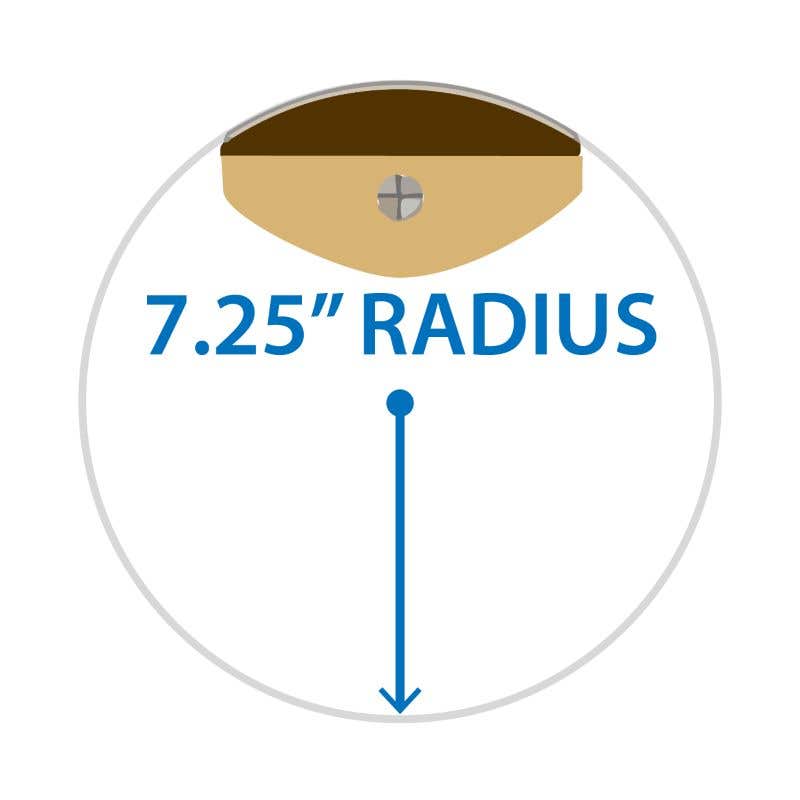
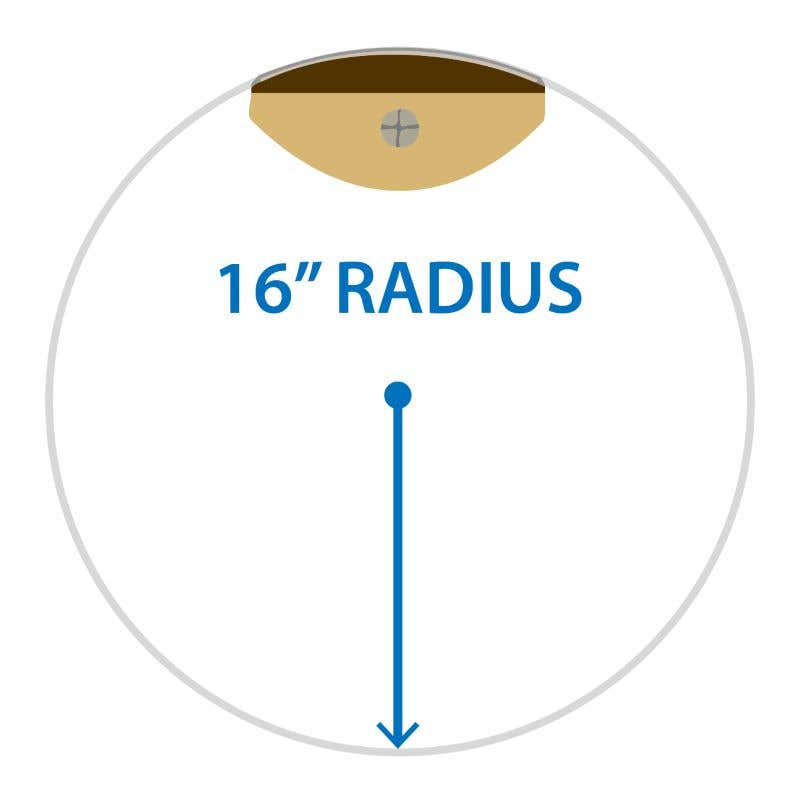
Fretboard radius is the curvature of the fretboard across the width. No, they’re not just flat pieces of wood — well, mostly. Fretboard radius is measured in inches, which signifies the diameter of a circle. So if you see a guitar with a 9.5” fretboard radius, it means that the curvature of the fretboard would fit perfectly with the outside of a circle with a 9.5” radius. The bigger the number, the flatter the fretboard.
I learned how to play guitar on a classical guitar, which typically have flat fretboards. Essentially all steel-string electric and acoustic guitars do have radiused fretboards.
How Fretboard Radius Affects Playability
When you reach your fingers around a guitar neck, it doesn’t look like a square with a flat top; it looks like a circle — or maybe a “C” shape to be more precise. Radiused fretboards match the curvature of your fingers, making playing much more comfortable.
Of course, some players prefer more or less radius than others because of things like hand size, finger length, anchor positioning, and down-right preference. That’s why it’s important to play with a variety of guitars and neck profiles to see which fretboard radius feels best for your hands.
To make matters worse (or better?), the fretboard radius has a different effect depending on the “zone” you are playing in. Most guitar rhythm parts are played in the “cowboy” zone of the first 4 frets. For playing comfort, a smaller fretboard radius generally feels more comfortable, as it more closely resembles the shape of your hand. As we move up the fretboard, things start to change as we start bending strings and soloing in the upper registers where a slightly flatter fretboard can sometime be more workable.
Common Fretboard Radius Sizes
Common fretboard radiuses ranges between 7.25” and 16”, depending on brand, model, and style of guitar.
Fender-style guitars (bolt on 25.5” scale) started out as 7.25” in the 1960’s and were quickly changed to 9.5” and remain so to this day.
Gibson style guitars (set neck, 24.75” scale) have usually used a 12” radius.
More modern “shredder” style guitars like Ibanez and Kramer use a flatter radius of 14” and 16”.
Paul Reed Smith tends to ride the center lane with a 10” radius on most models.
Most Martin acoustics have a 16” radius.
Most Taylor acoustics have a 15” radius.
And as noted above, most nylon string guitars have no radius.
What Is a Compound Radius Fretboard?
One of the reasons Fender switched to a larger fretboard radius was due to an effect called “sunsetting,” which happens when you bend a note far enough to have the string hit another fret and mute out. To allow for the comfort feel in “cowboy” zone and unlimited bending in the “solo” zone, a compound radius is used.
Compound radius fretboards gradually flatten out as you come up the neck, allowing almost unlimited bend range as you get into the “solo section.” It has a smaller fretboard radius at the nut and a larger fretboard radius as you get to the body. A compound radius is usually expressed with two numbers: the first being the radius at the nut, and the second the radius at the end of the fretboard.
Which Fretboard Radius is Best?
Just like all things in music, there is no “best” fretboard radius. It all depends on what’s most comfortable to you. However, your preferred musical style can be a big indicator of at least where you should start:
Rocker. A lot of rock involves moveable chord forms, barre chords, and “power” chord voicing with two fingers. A medium radius can be more fluid for this kind of work. For that reason, a lot of “rock” brands like Gibson usually use a medium 12” radius.

Blues & Country. A smaller radius has a slippery feel to it and lends itself well to a blues or country player’s approach. Two of the most iconic blues and country guitars, the Fender Stratocaster and Telecaster, both typically have 9.5” fretboard radiuses.


Classical. As noted earlier, traditional nylon string guitars have no radius. Taylor, Martin, and Alvarez offer “hybrid” nylon models with a very slight radius between 18” and 20”.
Find Your Perfect Fretboard Radius
There’s a corny 60’s expression that sums this up: “If it feels good, do it.”
Fretboard radius isn’t something that comes first to mind when shopping for a guitar or bass, but it is one of the subtle characteristics that affect the playing comfort and utility of any instrument. The size of your hands may guide you to a tighter or wider radius.
I have large hands, so I feel totally comfortable on a flat fretboard. But I also grew up playing a Strat, and Fender’s 9.5” radius feels immediately familiar to me. When I want to do some more jazzy chordal soloing, I reach for my trusty Gibson Les Paul Special or an ES339, both of which run a 12” radius.
You may hit on a size that feels sweet for your playing style regardless of genre. And remember, these are very general recommendations. Rules have always been made to break.
No matter how you get around your fretboard, we would love to have you get around to calling us at 800-458-4075. Our team of players can help answer any questions and maybe get you into something new. Now get out there and play some music!