![Best Budget Electric Guitar: Top Picks That Won’t Break the Bank [2025]](https://mcstaging.americanmusical.com/media/amasty/blog/cache/b/u/1200/600/budget_guitars_banner_resized.jpg)
There are a lot of compelling reasons for a player to want a more affordable guitar. Maybe it’s your first guitar and you don’t want to jump in with a huge investment. Or maybe you’re an experienced player looking for a backup or “beater” guitar. I’ve always disliked the word “beginner,” anyway. It implies you’ll need something better as your skills grow. When I hear “beginner guitar,” immediately jump to the dreaded “Strat-pack” or the even more evil Silvertone guitars I was eyeing in the old Sears catalog when I was a punk
But whatever your reason for wanting a less expensive guitar, we’re going to take a deep dive into some of the best electric guitars out there that won’t break the bank. No, they’re not the “cheapest.” Every guitar on this list is a serious player that just doesn’t have the same price tag as that Gibson Custom Shop Les Paul you’ve had in your cart for years now. Let’s look at some of the best budget electric guitars that won’t break the bank.
Epiphone LP100 Les Paul

Let’s kick things off with a familiar face: the Epiphone LP100 Les Paul. I was jokingly referring to this as the “Less” Paul because it’s a very basic model. But to be fair, it has all the necessary ingredients to rock out right alongside its more expensive Les Paul cousins.
The classic layout of two humbuckers with tone and volume each and a three-way toggle selector makes getting tones quick and easy. The fixed bridge and tailpiece keeps tuning solid. The bolt-on neck helps shave some production cost to bring this axe in under budget.
Overall, the fit and finish on the Epiphone LP100 Les Paul is excellent for this price point. This would make a great guitar for a beginner and a good “living room” axe to keep hours (and kids) off your more expensive instruments.
Epiphone Les Paul Classic

Taking things up a notch, the Epiphone Les Paul Classic features a set neck to bring more sustain, just like the big boys over at Gibson. You’ll also find the familiar layout of two alnico humbuckers with volume and tone each through a 3-way toggle selector for tons of tone-shaping abilities.
But what do you get for the couple extra hundred dollars? The Epi Les Paul Classic comes with push/pull coil taps in the volume knobs, so you can transform those humbuckers into single coils for even more tonal options! And the new “mustache” headstock is angled 14 degrees to provide maximum string tension through the nut. The signature carved and bound top and fretboard finish things off nicely.
Coming in four different finishes, there’s a Les Paul Classic to fit any style. This will make a great back-up stage guitar if you already gig a Les Paul, or it could be a great beginner model that’s way above your average starter guitar.
Paul Reed Smith SE CE24 Standard Satin


For a sub-$500 price point, Paul and his team have hit it out of the park with the PRS SE CE24 Standard. Their proven recipe of carved maple top over mahogany body and bolt-on neck with offset heel makes for great “snappy” tone and easy access to the 24-fret neck. Plus, the transparent satin stain finish does a great job of accentuating the beautiful contours of the body.
PRS usually likes to ride right between Gibson and Fender in scale length and fretboard radius, and they hold true with the SE CE24 with 25” scale and 10” radius. Paul’s patented molded tremolo bridge keeps tune even when used with enthusiasm.
The electronics are simple but effective with two PRS 85/15 “S” humbuckers, volume and tone with push/pull coil tap and 3-way selector toggle.
For an added bonus, the PRS SE CE24 ships in a high-quality gig bag! This would make killer main guitar or a backup gig guitar if you already have a core series PRS. I would love to see a kid get one of these as a first guitar.
Ibanez RG421S

With more than a nod to the metal genre, the Ibanez RG421S is no-nonsense shredder. The sleek double cutaway body helps you reach every single one of the 24 frets, and an extra-wide belly contour provides effortless playing comfort.
For maximum tuning stability the RG421S’s fixed bridge anchors the strings through the body. Ibanez’s famous two-octave Wizard III neck profile is ultra-thin with a flattened 15.75” radius on jumbo frets and 25.5” scale for unlimited speed and playability.
The electronics on the RG421S are super straightforward with two Quantum humbuckers wired for 5-way blade switch operation. The satin finish really shows off the lines on this body and is very video friendly (no flares under lights). These tend to run light in weight and would be great for a younger player or as a hard tail backup for a stage set or unusual tuning.
Schecter C1 Standard


I’ve always been impressed with Schecter’s fit and finish at every price point, and the Schecter C1 Standard is no disappointment. This is the perfect recipe for great shredder that can cross any genre line.
The C1 is outfitted with blacked-out hardware and satin finish for a video- and stage-friendly finish. Dual humbuckers with tone and volume, connected to a three-way toggle switch make it easy to grab up the tones.
The body on the C1 is flat topped with cutaway access contours on the back and a huge belly carve. And using mahogany for the body helps keep the weight down.
Schecter made some interesting finish options for the C1 that are sure to turn some heads: Blood Burst, Black Fade Burst Burl, and Charcoal Satin (my favorite). It’s unusual to see a roasted maple neck at this price, but they pulled it off in a 25.5” scale, two-octave neck with a modestly flat 14” fingerboard radius. The hardtail, string-through body bridge design would make this a great second guitar for altered tunings, and a graphite nut helps this be a super stable tuner for a newer player or a seasoned road dog.
ESP LTD Viper 256
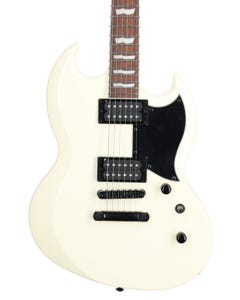
The crew at LTD always seems to put a little extra spin on familiar shapes, and the LTD Viper 256 does exactly that. The slender mahogany body has offset double cutaways and is steeply beveled for max handling comfort. The three-piece mahogany neck has a substantial feeling “Thin U” shape, and they did the right thing giving you a proper glued-in neck joint at a price where almost everyone else is using screws.
The 24.75” scale length should feel right at home to most players. And combined with 3-on-a-side tuners make the string tension feel just right. The classic electronic setup with dual humbuckers connected to a single volume and tone is updated with a push-pull coil tap for even more tonal options. The Tune-O-Matic bridge and stud-mounted tailpiece assure rock-solid tuning stability that would make this a great guitar for downtuning.
Squier Affinity Stratocaster


At the end of the day, and this list, there’s nothing like a Strat. Squier offers a pretty serious contender with the Squier Affinity Stratocaster. Being the younger sibling to a legacy brand like Fender will always invite comparison, and in this case the Affinity Strat scores high marks. If you don’t have a Strat in your arsenal yet, this would be a great place to start.
The Affinity comes out of the box ready to rock with a great setup and tons of playability. Squier sticks with the classic layout of three single-coil pickups and two tone and one volume switched through a 5-way blade selector. The tremolo bridge is mounted with two studs to enhance tuning stability.
These guitars tend to run light in weight, making the Squier Affinity an excellent choice for a younger player. For a deeper dive on Squier vs. Fender, check out my blog.
A Note to the Folks at Home
In many instances, a first guitar is a present from the folks. I have been in the business of selling guitars for over 40 years, and I have set up thousands of new players in that time.
Many times, the first purchase is the least costly, with the logic being that they will upgrade as the player improves. In the band and orchestra world, this “step-up” system is very codified — but not so much in the electric world. I would suggest that many aspiring guitarists never made it to the “step-up” phase because their first guitar was practically unplayable.
As an experienced player, I can muscle my way around on almost any setup, but a beginner player will benefit the most from having a well-made, well-set-up instrument. When you think about it, the most important part of picking a first instrument is the fact that your kid WANTS to play it and spend many hours with it in their hands. So let’s make it as cool as we can to begin with, even if it costs a few extra bucks.
Any guitar on this list would be a great option for beginner players just starting out. They’re well made, sound good, and nice to look at. Don’t get tempted by the super-cheap budget options you find at Walmart…
Budget-Friendly Electric Guitar Buys at AMS
Whether you’re getting ready for the gifting season or binge-shopping for yourself, there are plenty of budget-friendly electric guitars out there that won’t break the bank. Our team of Gear Acquisition Specialists is standing by to help guide you toward your perfect guitar. Call us toll-free at 800-458-4076. We ship VERY fast, so you can get to playing your new guitar in no time. Find your next budget-friendly axe today!

Headrush FRFR112 MKII 2500 Watt Powered Cab with Bluetooth
Special Price $399.00

Orange Glenn Hughes Crush Bass 50 LTD Combo 1x12 50 Watts
Special Price $399.00
Headrush FRFR108 MKII 2000 Watt Powered Cab with Bluetooth
Special Price $299.00