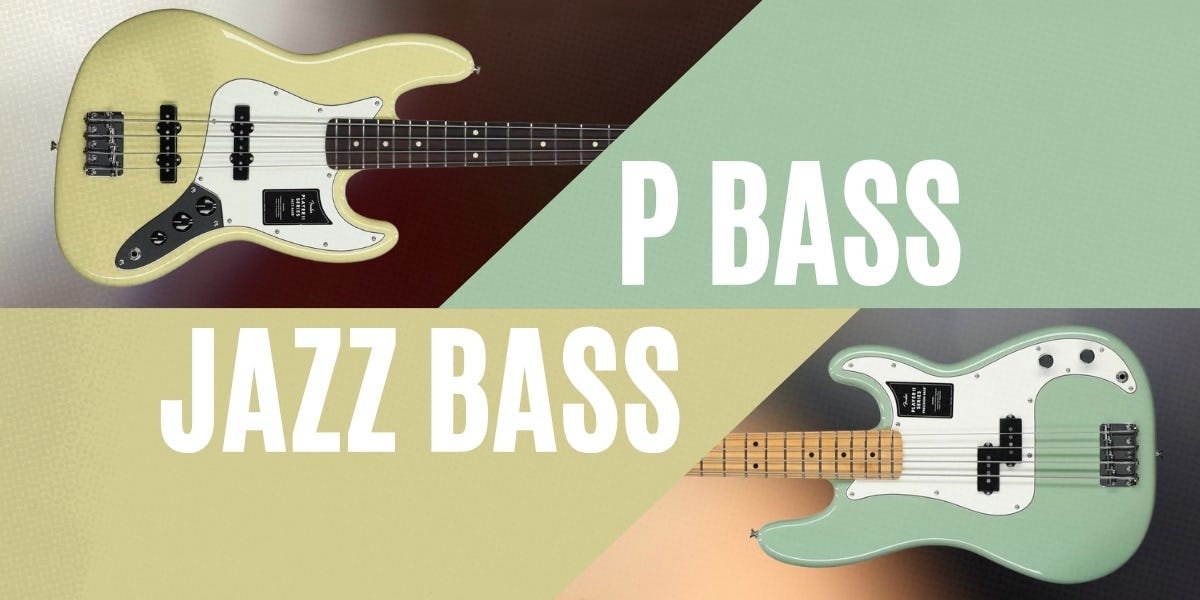
When you think of legendary bass guitars, two models jump to the front of the line: the Fender Precision Bass and the Fender Jazz Bass. Both have been hugely influential in modern music, but they’re built for specific tones and music styles. Let’s take a closer look into what sets them apart.
History of P Bass vs. Jazz Bass

The Precision Bass (P Bass) came first — introduced by Fender in 1951. It was the first mass-produced electric bass guitar and got its name from its fretted neck, which gave players "precision" over pitch. Before this, there was not a fretted electric bass guitar.
The Jazz Bass (J Bass) showed up in 1960. It was originally called the Deluxe, and it was considered a partner for the Fender Jazzmaster guitar that had been introduced two years earlier. The J Bass was primarily aimed at jazz players, but it found a home in just about every genre.

Design Differences Between the Fender Jazz Bass and P Bass
Body Shape: The Jazz Bass is sleeker and slenderer than the chunkier P Bass. The P Bass also features a quirky thumb rest, specifically designed for thumb playing. This was how a bassist was “supposed to play” in Leo Fender’s vision. Modern players tend to ignore it or even remove it.
Neck: The J Bass has a slimmer neck, especially at the nut. It’s faster and easier to navigate for many players. The P Bass has a wider neck that feels more substantial with a lot more real estate to grab onto.
Pickups: P Bass has one split-coil pickup right in the middle. There’s also a reverse pickup option for the P Bass. The J Bass has two single-coils — one near the neck, one near the bridge, giving it the edge in terms of tonal versatility.
Controls: The Precision Bass is super simple with two control knobs: volume and tone. The J Bass gives you two volume knobs (one for each pickup) and a tone control. Since manufacturers like to make "special" models, this is just the standard. You can easily find both P Basses and Jazz Basses with different knob configurations.
Tone Differences
The P Bass is punchy, and focused, great for rock, punk, Motown, and country. It sits in the mix like a rock — think Boz Scaggs–Lido Shuffle. That’s the P Bass sound.
The Fender Jazz Bass is brighter, more articulate, and a little more growly. It’s got more tonal variety and works great for funk, fusion, and anything where the bass needs to move around a bit more. Geddy Lee from Rush famously uses a J Bass, and its growly, snarly tone stands out on records like Tom Sawyer.
Which One Should You Pick: Fender P Bass vs. Jazz Bass
If you want something simple, punchy, and rock-solid, the P Bass is a classic that’ll never go out of style. If you want a thinner neck, a bit more tonal flexibility, and a snappier sound, the Jazz Bass might be more your speed. Of course, this is purely personal preference, but if it was me and I was just starting on bass, I’d probably lean towards the J Bass because the neck is a little more comfortable and easier to play. It also has a little more tonal versatility than the P Bass.
And if you’re still on the fence… why not just get one of each!? They both bring something unique to the table, and if you’re serious about your tone or switching styles, having both in your arsenal makes a lot of sense. The good news? With AMS’s always-interest-free payment plans, grabbing that second bass isn’t just a dream — it’s actually doable. You can also check out Squier Basses for more affordable versions of both P Basses and Jazz Basses.