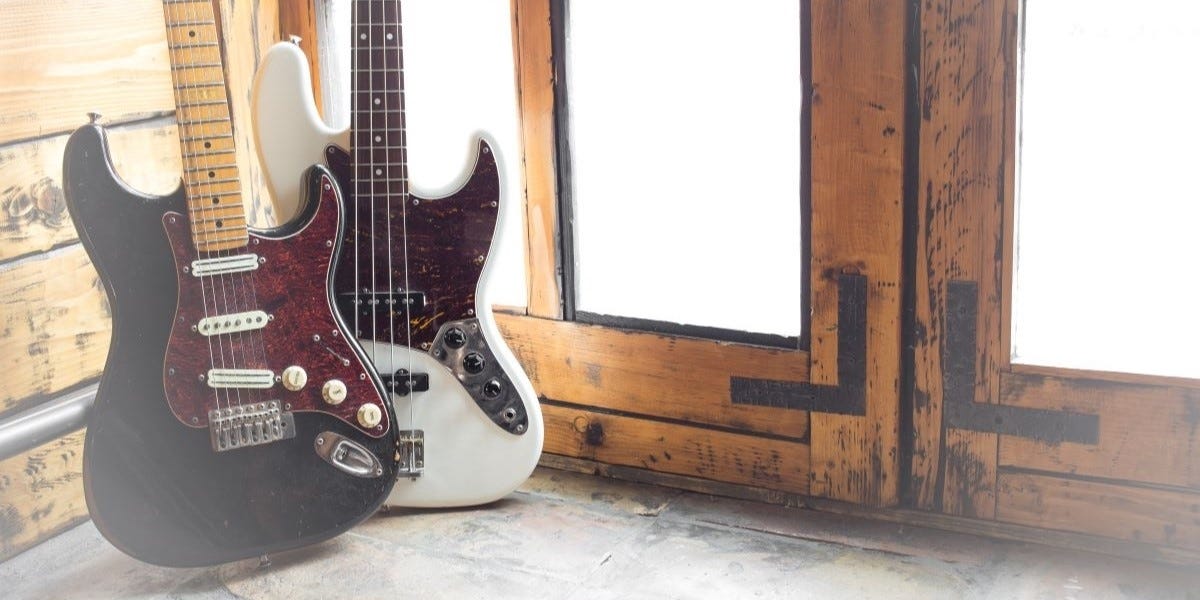
Most of us gearheads can spot the brand of a guitar from a moving car. But it would sometimes take a savvy eye to spot a Fender from a Squier, as Squier is solely licensed to make exact reproductions of Fender’s body and headstock shapes, in addition to using the same model names. It would be a fair question to wonder which train to jump on being that the product is so similar. Let’s take a closer look at the differences between Squier vs. Fender.
Country of Origin
In 1982 Fender created the Squier brand. Their goal was to produce an affordable instrument for beginners to introduce them to the Fender family.
Initial production was contracted with FujiGen, a major supplier to Ibanez at the time, in Nagaro Japan. Over the next 43 years, production would be moved to factories all over Asia, India, Indonesia, Korea, and even Mexico and, briefly, in America.
Current production for Fender is in the United States (California, more specifically) and Mexico, while Squier is in China and Indonesia.
But let’s face it: The physical location of the factory has very little to do with any expectation of quality. A better metric to gauge the potential for a quality outcome would be:
- The amount of money invested in the machinery and facilities to shape and finish the raw materials into finished goods.
- The amount of money invested in human resources to operate and maintain the facility.
- The amount of money invested in the raw materials needed.
- The amount of money invested process monitoring and quality control.
At the end of the day, we could probably build an amazing facility anywhere in the world. And we have, mostly in places in the world with a relatively low cost of living. The cost of tooling is pretty much the same no matter where you plan to use it, and the price of raw materials is also consistent, so the only real variable in cost is the cost of human resources. The lower the cost of living, the lower the cost for labor, and the lower the cost of production — meaning Squier can provide much cheaper guitars. Speaking of…
Price
It’s no secret that Fender and Squier occupy different price points. Fender guitars start at $600 and go upwards into the thousands for a high-end American-made guitar. You can get a Squier for less than $250, and they go up to around $600 to meet the Fender lineup — which make them a great starting point for beginners.
If you had an endless supply of money, you would probably buy as many Fenders as you have room for in your music room. Please call us when you are running low…
It used to be the case that Squier guitars and basses needed a little attention to be playable and maybe some upgraded components as well. More recently, Squier has done a great job in upping the quality of their guitars (and the price) so they can be competitive and draw more players into the Fender family right out of the box.
Tonewoods
Fender typically uses maple for necks and alder or ash for bodies. Squier typically uses maple for necks and basswood for bodies.
Over the years Squier has used poplar, pine and even plywood for bodies. Regardless of manufacturer or wood type, it seems that a lighter body makes for a slightly “crisper” tone.
Electronics
Electronics are arguably the most drastic difference between Squier vs. Fender. On a Fender pickup, six magnetic pole-pieces are wrapped with copper wire and sit just beneath each string. Each string is grounded, and the magnets react to the presence of a potential for ground. Each magnet has its own magnetic flow out of the top of the pole-piece and “spilling down,” so each string is a similar volume and retains a distinctive tone.
Squier pickups usually have a similar setup, but the pole pieces are steel, and a magnet is attached to the back, giving all the pole the same magnetic flow. This causes a little less “definition” of each string and can make the inside pole pieces have a little less output than the outer ones.
All my Squier guitars are older and have already been upgraded to US electronics, so I thought it would be fair to purchase a new Squier to do some blind taste-testing. I ordered a Squier Classic Vibe Jazzmaster. AB play testing next to American electronics was edifying: The Squier is a formidable guitar, but the US electronics in my Strat do have a little more “presence.” What is very different is the way the controls respond.
A lot of expense in the electronics is devoted to the potentiometers and capacitors used in the tone and volume controls, The potentiometer (pot) is essentially a rotary wiper that slowly increases the voltage in the circuit. The size of the coil is what determines the cost of the part. A smaller coil (Squier) will not be “linear” in its performance. You might see nearly full volume in the first 50% of the pot. A larger coil (Fender US) will remain linear throughout the range of the pot. This seems like minor thing, but it means a lot when you are running a higher gain system and using your volume control to overdrive your amp. You’ll also see the same issue with the tone controls.
Another area of difference is the pickup switch. Fender guitars usually have switches that allow for the contact points to be cleaned if any oxidation affects their contact points. Squier uses sealed switches that need to be replaced if service is required.
Playability
To continue our mini shootout, let’s talk about playability. Obviously, Fender guitars and basses play amazing. There’s a reason they’re used by the pros!
But perhaps surprisingly, the Squier is remarkably well mannered in the playability department. I went through the set up and, with a light tightening of the truss rod, the neck of my Squier Jazzmaster runs true and straight with excellent fretwork and overall finish detail.
I hate to make a general statement about playability between Fender and Squier because I have set up many Squiers to play better than some Fenders. With a little tweaking, the Squier vs. Fender playability debate might come out as a draw.
Body Shapes and Models
Since Fender is sharing their CAD files with Squier, the shapes should be almost identical to models that are also made in USA. Early Squier models (Bullet) had thinner bodies and no “comfort contours.” However today, they’re more or less identical in both body shapes and model names.
Since Squier is less beholden to tradition than Fender, they have been free to come up with many unusual combinations of shapes, headstocks, and pickup configurations that might not be available from Fender US. Keep an eye out for some unique Squiers!
Which Should You Choose: Squier vs. Fender
Obviously, Fenders are more popular and coveted than Squiers. They’re North American made (US models are especially sought after), they have the best electronics, and they have the entire Fender legacy behind them — Jimi Hendrix, Eric Clapton, Stevie Ray Vaughn, David Gilmour… You get the idea.
However, if Fender’s designs appeal to you, Squier can be an affordable way to explore a model before you make the investment in a Fender. They’re still great guitars in terms of both materials and playability, just at a fraction of the cost. You might not have guitar nerds whipping their heads around to get a better look at it, but it’ll still sound and play great — plus you’ll still have a full wallet.
“Investment” is a key word here. The resale value of all these things bears into the equation, and obviously Fenders have higher resale value and wider market appeal in the collector’s market.
Personally, I intend to play all my guitars until they turn to dust, so I really don’t care what the “market value” is on anything. My Squier Jazzmaster plays great. But then again, so does my Fender Stratocaster. At the end of the day, it’s really up to you and your budget.
Squier vs. Fender: The Great Debate Continues
Now that you know a little something about the Squier vs. Fender debate, it’s time to choose a side! If you want to speak with one our Gear Acquisition counselors, give us a call at 800-458-4075. Every one of our customer service reps are musicians and can go over any details about our selection, 0% interest payment plans (if you want that USA Fender) and shipping estimates. Don’t forget about our 45-day satisfaction guarantee, which is always a good way to feel things out. And whether you choose a Fender or a Squier, you know you’ll come out on top just because you’ll have a guitar or bass in your hands.