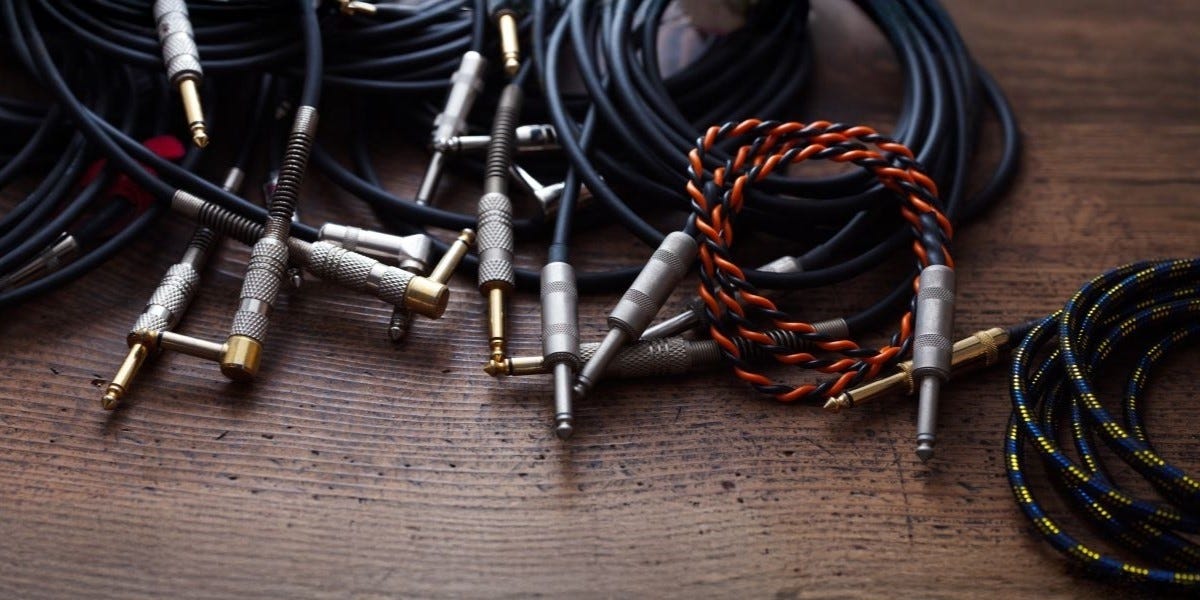
To the untrained eye, instrument cables and speaker cables might look similar. They often have the same 1/4-inch connectors, come in similar lengths, and they’re both used by guitar and bass players onstage. But treating them as interchangeable is a mistake — one that can cost you hundreds of dollars in gear damage… and possibly a ruined show.
I know this from personal experience.
Here’s the difference between instrument cables vs. speaker cables and when to use each — so you don’t blow something up (spoilers).
The Night My Dream Rig Went Up in Smoke
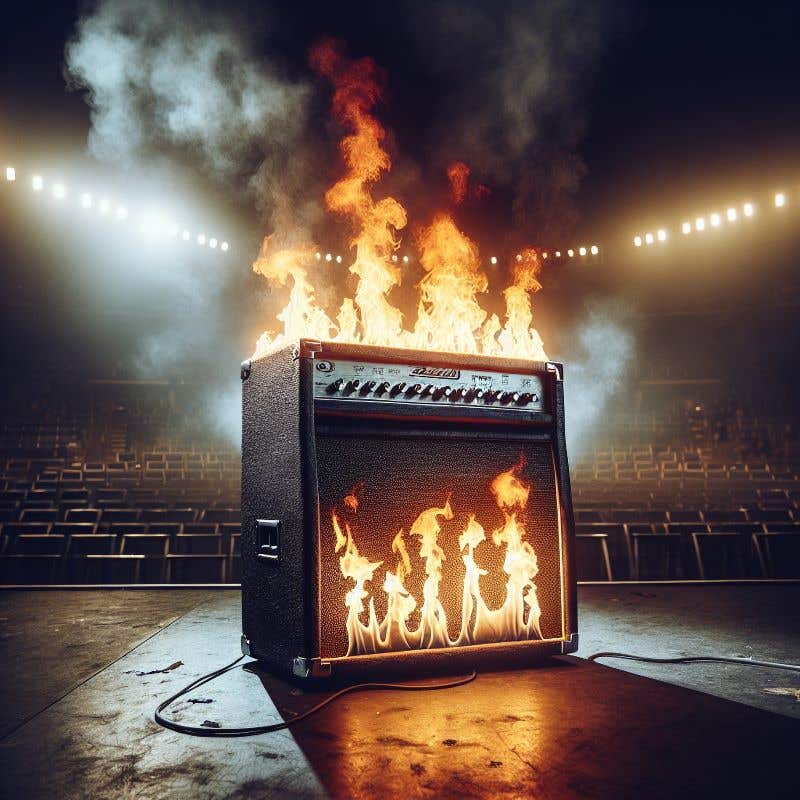
Sometime in 2002 or 2003 (I honestly can’t remember exactly) I had just treated myself to a Mesa Boogie F-100 head paired with a 2x12 cab loaded with Celestion Greenbacks. It was a serious rig and one I was proud of. My band was playing a local showcase featuring original bands at a bar in a suburb of St. Paul, MN. About ten minutes before the opening band was set to play, the guitarist nervously asked if he could borrow my amp. His wasn’t powering up, and he was in a tough spot.
I said yes, somewhat reluctantly. He seemed like a good dude, and we musicians try to help each other out when we can. But looking back, the fact that his amp had just failed should’ve been a red flag — because a few songs later, mine went up in smoke.
I saw a flash. I smelled burning electronics. Then silence. My Mesa was toast.
What happened? Turns out, he had used a standard instrument cable to connect my amp head to his speaker cabinet. If you don’t already know why that’s a problem, this is the blog for you!
That one oversight fried the output transformer. Fun fact: “Accidental amp barbecue via instrument cable” isn’t listed under any manufacturer’s warranty I’ve seen. The repair cost was so high that I ended up replacing the entire amp. To his credit, the guitarist took responsibility and helped pay for the replacement — but the show was ruined, and he and I both learned a hard lesson about cable types that night.
So What's Actually the Difference Between an Instrument Cable vs. Speaker Cable?

Instrument cables are designed to carry low-voltage, high-impedance signals from a guitar or bass to an amplifier or pedalboard. These cables are shielded, meaning they’re wrapped in a conductive layer that helps block out noise and interference. That’s crucial when dealing with low-level signals, especially in environments full of lighting rigs and other sources of hum and buzz.
Speaker cables, on the other hand, carry high-power signals from an amp head to a speaker cabinet. These are unshielded and use thicker internal wire — usually around 14 gauge or lower — to handle the much higher current without overheating or introducing resistance that could damage the amp. (And just in case you’re new to this: the lower the gauge number, the thicker the wire. Yeah, it’s backwards, and yeah, it hit me as weird too back in the day.) In other words, a speaker cable is built to move power, not just signal.

Plug an instrument cable where a speaker cable should go, and you’re creating a bottleneck for the current. That causes heat buildup, voltage spikes, and in some cases, a blown output transformer — the heart and soul of a tube amp.
Why This Still Happens Today
Back in the early 2000s when my incident happened, almost all speaker cables in the guitar and bass world had 1/4-inch connectors on both ends. They looked nearly identical to instrument cables, which made it dangerously easy to mix them up — especially under stage lighting with a sense of urgency and noise all around.
Thankfully, things have improved in recent years. More and more manufacturers are switching over to Speakon connectors, especially in bass rigs and modern PA systems. These twist-and-lock connectors not only offer a more secure connection but also eliminate the visual confusion.
If your cab has a Speakon input, there’s no way you’re going to accidentally plug in an instrument cable. That said, plenty of 1/4-inch speaker jacks are still out there, and mistakes still happen. Knowing your cables and labeling them clearly is a habit that pays off. It also never hurts to read the writing on the cable. Sometimes manufacturers are nice and write “speaker cable” or “instrument cable” right on the side, usually near the tip.
Pig Hog Cables: Premium Quality Without the Premium Price
When it comes to reliable cables, Pig Hog is a brand that strikes a perfect balance between durability, tone integrity, and affordability. Their instrument cables, like the Pig Hog 25-foot Right Angle Instrument Cable, are built with heavy-duty shielding and durable jackets that hold up to road use without compromising your sound.
If you’re running a head and cab setup, a good speaker cable is essential. The Pig Hog 14-gauge 8mm Speaker Cable is designed specifically for high-power applications, giving you plenty of comfort that your amp and cabinet are connected properly without the risk of damage.
For rigs that involve hybrid connections, the Pig Hog PHSC5S14 Pig Hog Speaker Cable 5 Feet is a great solution. Many modern bass amps and PA systems use Speakon on one end and traditional 1/4" on the other, so having a cable like this in your gig bag is just smart prep.

Pig Hog PH25R Right Angle Instrument Cable 25 Feet
Special Price $37.95


Bottom Line: The Right Cable Protects Your Tone — and Your Gear
If you’ve read this far, take this away with you: never use an instrument cable to connect an amp to a speaker. Ever. No matter how similar they look, they are fundamentally different in how they’re constructed and what they’re built to do. It’s a rookie mistake that even veterans have made — including yours truly.
Thankfully, brands like Pig Hog make it easier than ever to get high-quality, clearly labeled cables at a price that won’t wreck your budget. If you’re building or upgrading your rig, spend a few extra bucks on the right cables. It could save you hundreds (or thousands) down the line.
Because when your amp goes silent in the middle of a gig, and the smell of burning PCBs and scorched resistors fills the room, trust me — there’s no solo you can play to win the crowd back after that.